Banks spent years treating transaction data quality as something to show. A list, a balance change, maybe a PDF statement. Now the better ones treat transaction data as something to build on: Year-in-Review recaps, subscription controls, advanced PFM, loyalty targeting, carbon footprint views. Yet the market is all over the place.
- One bank can generate an annual “Year in Review” based on spending and activity.
- Another can show per-transaction CO2 footprints and monthly impact summaries.
- Another runs advanced search, filtering, and AI-style insights built on transaction context.
- And plenty still dump a large share of spend into “Other,” because the underlying merchant and category data never got clean enough to support anything smarter.
Same category of product, radically different outcomes. The differentiator is the transaction data quality.
Tapix helps banks fuel digital banking features with quality transaction data by enriching raw payment strings into structured, reliable merchant and category context across card payments, transfers, QR, and open banking inputs. On top of Tapix-enriched data, banks can build subscription controls, smart search and filters, PFM insights, loyalty targeting, and sustainability features like per-transaction CO2 views. What makes these solutions work or fail is not the UI layer.
So, what can be built on enriched transaction data? And what needs to happen before that? Let’s take a quick peak in our whitepaper and introduce you to a core idea.
Data quality makes or breaks features
What determines whether features succeed or fail is data quality, which we can devide into three pillars:
- Information richness - Richness is depth. How much meaningful context you can attach to a transaction beyond the basics? It’s about identifying the real merchant behind payment gateways, store-level precision, localised names/URLs, and sustainability signals such as CO₂ footprints or eco tags.
- Coverage - Coverage is breadth. What share of transactions actually become “enriched” enough to support search, subscriptions, loyalty logic, and reporting? Tapix enriches over a billion transactions per month with coverage as high as 95% for categorisation and 85% for brand recognition.
- Accuracy - Accuracy is correctness per datapoint. One wrong merchant, one wrong category, one wrong subscription detection, and users stop trusting the product. It has direct business impact and is a core differentiator.
Learn more about data quality and how banks use it in our article.
KPI-first focus and what improves it
Most banks build features first and then discover the data can’t support them. Start with the KPI. If you know what you’re trying to move, you can pick the right capabilities and the enrichment requirements become specific.
If your problem is cost
Focus on support load, disputes, chargebacks, and fraud losses. Confusing transactions create operational work, clear out the mess with:
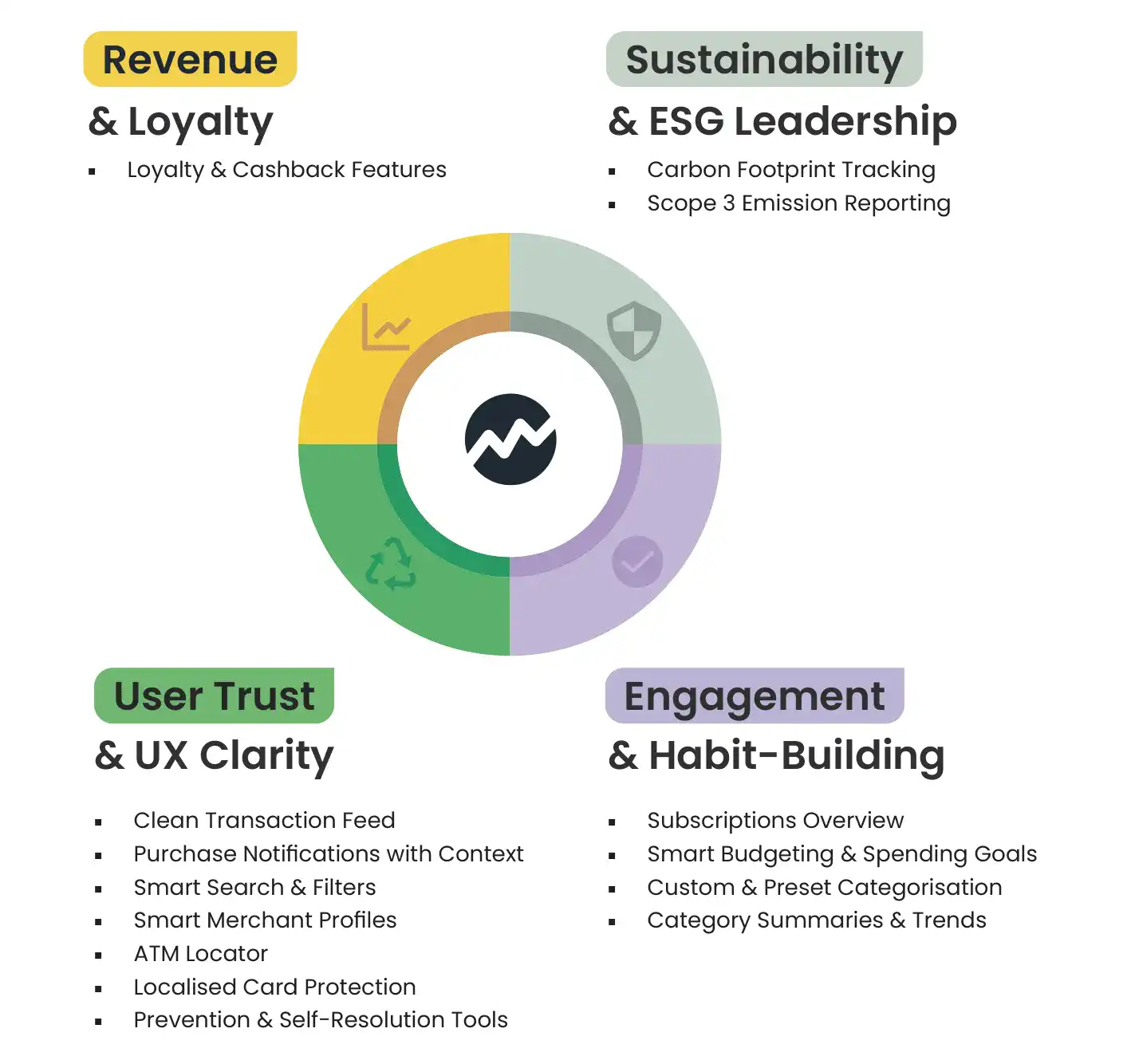
- Clean transaction feed: consistent merchant identity, plus logo, category, and GPS/location where available. Reduces “I don’t recognise this” cases.
- Smart search & filters: search by merchant, category, tags, amount, keyword so users find answers without contacting support.
- Smart merchant profiles: merchant-level history and totals once merchant identity is stable.
- Purchase notifications with context: real-time alerts enriched with merchant, category, and distance/location context; improves user confirmation and supports fraud detection.
- Localised card protection: proximity logic using device location + merchant location to reduce fraud and chargebacks without blunt blocking.
If your problem is usage
Focus on engagement, insight adoption, and churn. People use PFM when insights feel consistent and fair. That requires stable enrichment like:
- Subscriptions overview: recurring detection using recurring tags, frequency, merchant recognition, and amount to surface subscriptions, flag duplicates, and detect price increases.
- Smart budgeting & spending goals: depends on trustworthy categories and tags so budgets don’t collapse into “Other.”
- Custom & preset categorisation: users rename/recategorise via merchant identity, categories, and custom labels/tags, stabilising their personal model.
- Category summaries & trends: trend views driven by category, time, amount, and tags to create a repeatable habit loop.
If your problem is growth
Focus on loyalty performance, partner revenue, and redemption. Loyalty breaks when merchant attribution breaks. Enrichment makes attribution reliable with:
- Loyalty & cashback features: targeting based on merchant identity, frequency, spend patterns, categories, and clean history; supports credible partner reporting and measurement.
If your problem is differentiation
Focus on ESG engagement and reporting credibility. Sustainability features only work when the underlying categorisation and metadata are consistent enough to be trusted. Keep up with:
- Carbon footprint tracking: per-transaction estimates using merchant category, ESG tags, location, and CO₂ metadata, plus monthly summaries.
- Scope 3 emission reporting: reporting enablement via enriched transaction metadata (requires the same stability: categories, merchant resolution, and consistent mapping).
Did you know?
7 Digital Banking KPIs banks shoud focus on!
Plenty of banks can copy a feature UI. Far fewer can ship it without breaking trust, inflating support costs, or corrupting analytics because data quality wasn’t strong enough.
For the full solution map context, including the underlying logic, data requirements, and ownership per capability, the whitepaper Payment Data in Action goes deeper and uncovers more.
