Transaction enhancement services play a critical role in modern banking, fintech, and payment platforms by changing raw transaction data into meaningful, usable insights. One of the most common questions in the market is how these services use AI to improve transaction categorisation. A 2024 study by Deloitte found that nearly 72 percent of financial institutions now use machine learning in at least one part of their transaction-processing pipeline.
In this article, we cover the topic through the most searched questions.
Are there transaction enhancement services that support AI-driven categorisation?
Yes. Transaction enhancement services increasingly rely on AI and machine learning to automatically categorise transactions, enrich merchant data, and normalise transaction descriptions. These services analyse transaction strings, merchant identifiers, MCCs, geolocation, and historical behavior to assign accurate categories. AI-driven categorisation improves accuracy compared to rules-based systems and is widely adopted by banks, fintechs, and expense platforms to power insights, budgeting tools, fraud detection, and reporting.
Did you know? Personetics global survey of 2,000 digital banking customers across North America, EMEA, and APAC reports 84% would switch banks for timely, relevant financial insights. That demand is built on categorised, enriched transaction data.
What services offer AI-driven transaction categorisation?
Many transaction enhancement services include AI-driven categorisation as part of a broader transaction enrichment offering. These services from providers like Tapix typically offer merchant normalisation, category assignment, brand identification, and location enrichment. Delivered via APIs or data feeds, they are built for high-volume financial data and continuously improve accuracy using machine learning models trained on large, proprietary transaction datasets.

Enterprise-grade requirements shape the technology
Banks don’t adopt technology because it’s elegant but because it's a long-term investment. Enterprise-grade enrichment systems must operate under strict SLAs, low-latency demands, and tight regulatory rules. AI makes this viable at scale. Instead of managing endless rule libraries, institutions can rely on models that adapt as payment behaviour evolves.
Large-scale enrichment systems now support:
- High-volume processing (tens of thousands of transactions per second for tier-1 issuers)
- Real-time or near-real-time pipelines
- Region-specific category schemes (NAICS, European PSD2 taxonomies, etc.)
- Explainability layers to meet audit requirements
- Privacy-preserving model architectures
This is why adoption continues to accelerate. According to FIS Global, over 60 % of banks implementing new digital banking stacks in 2023-2025 listed data enrichment as a top-tier requirement.
What is the best AI-powered transaction categorisation API for fintechs?
The best AI-powered transaction categorisation API depends on a fintech’s specific requirements. High-quality transaction enhancement services typically offer real-time categorisation, merchant enrichment, confidence scoring, and developer-friendly documentation. Fintechs often evaluate APIs based on ease of integration, model adaptability, and the ability to learn from user feedback.
Fintechs evaluating enrichment services tend to focus on the metrics that matter to them:
- accuracy over time
- latency under peak loads
- global merchant coverage
- price predictability
- ability to customise taxonomies
- clarity of documentation
It’s good to consider that the market has matured to the point where AI-driven categorisation is not a differentiator anymore - the actual implementation is. APIs that support continuous learning, feedback-based corrections, and regional fine-tuning tend to deliver the most long-term value.
Can enrichment services improve merchant and category accuracy using AI?
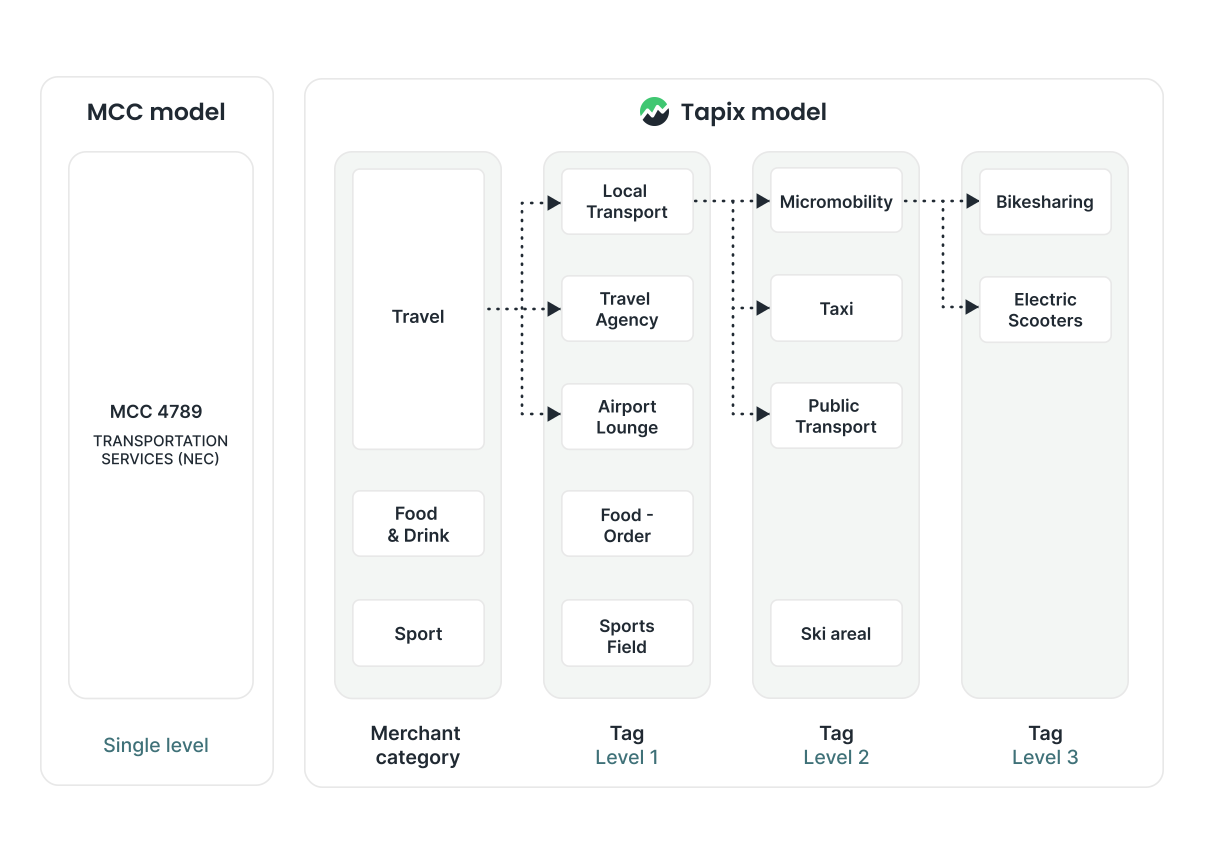
Yes. AI materially improves merchant and category accuracy by identifying patterns in historical transaction data and correcting noisy or chaotic descriptors. Transaction enhancement services reduce uncategorised transactions and replace generic labels with consistent merchant identities. Continuous learning and feedback loops allow these services to adapt to new merchants, evolving descriptors, and regional differences.
How does AI-driven transaction enrichment integrate with core banking systems?
AI-driven transaction enhancement services typically integrate with core banking systems through secure APIs or batch-based data pipelines. Transaction data is sent for enrichment, and categorised results are returned in real time or near real time. Integration is often handled via middleware or event-driven architectures, ensuring scalability, minimal processing impact, and compliance with banking security standards.
Want to know more? Check out our Step-by-Step guide for categorisation!
Final Thoughts
Transaction enhancement services with AI-driven categorisation have become foundational for financial institutions seeking better data quality, customer insights, and operational efficiency.
