Most chargebacks start with a line in the banking app the customer can't place. Insightful transaction details answer the question "what is this?" before the customer reaches for the dispute button, which makes them one of the cheapest dispute-prevention tools an issuer has. This article covers why confusion turns into chargebacks, what it costs, and which data points do the work.
Why transaction confusion turns into chargebacks
A raw card transaction carries a short merchant string, an MCC code and sometimes a city. The customer sees "PAYPAL*SPTFY 4029357733" or the legal entity behind their local café, not the name on the shop sign. When nothing in the app matches their memory of the purchase, the safest move from their side is to flag it as fraud.

Mastercard research with Datos Insights (2026) found that 44% of consumers don't recognise one or more of their purchases, and 56% of those concluded the unfamiliar transaction was fraudulent. The same research puts the share of consumers who have mistakenly disputed a legitimate charge at 48%. These customers aren't trying to cheat anyone. They are working with a transaction feed that gave them too little to go on.
Ethoca's 2024 Digital Banking Trends Report adds that 79% of consumers have reported an unrecognised transaction to their bank. Every one of those reports lands with the issuer, whether it ends as a support call, a formal dispute or a chargeback.
Learn more about this transition through the success story of Dutch fintech bunq

What a preventable dispute costs the bank
The issuer rarely absorbs the transaction amount itself, but it always pays for the process. According to Mastercard's 2025 chargebacks outlook, based on Datos Insights research, each disputed transaction costs a financial institution between $9.08 and $10.32 to handle.
Volume is moving the wrong way. Mastercard's 2026 research with Datos Insights projects global chargebacks to reach around 359 million a year by 2029, up 37% from 2025, with Europe expected to reach 29.2 million. Issuers can see part of the reason: in Mastercard's 2026 research with Javelin, 83% of issuers said chargebacks are rising partly because more customers are learning that they can dispute a charge.
Timing decides how much of that cost is avoidable. Scheme deflection tools step in after the customer has already raised an inquiry. Clear transaction details work earlier, across the whole feed, before the customer decides anything is wrong. That is the logic behind building dispute and chargeback reduction on enriched data.
The transaction details that stop a dispute before it starts
Each data point below answers one version of the customer's question. Together they turn "I don't recognise this" into "that was me".
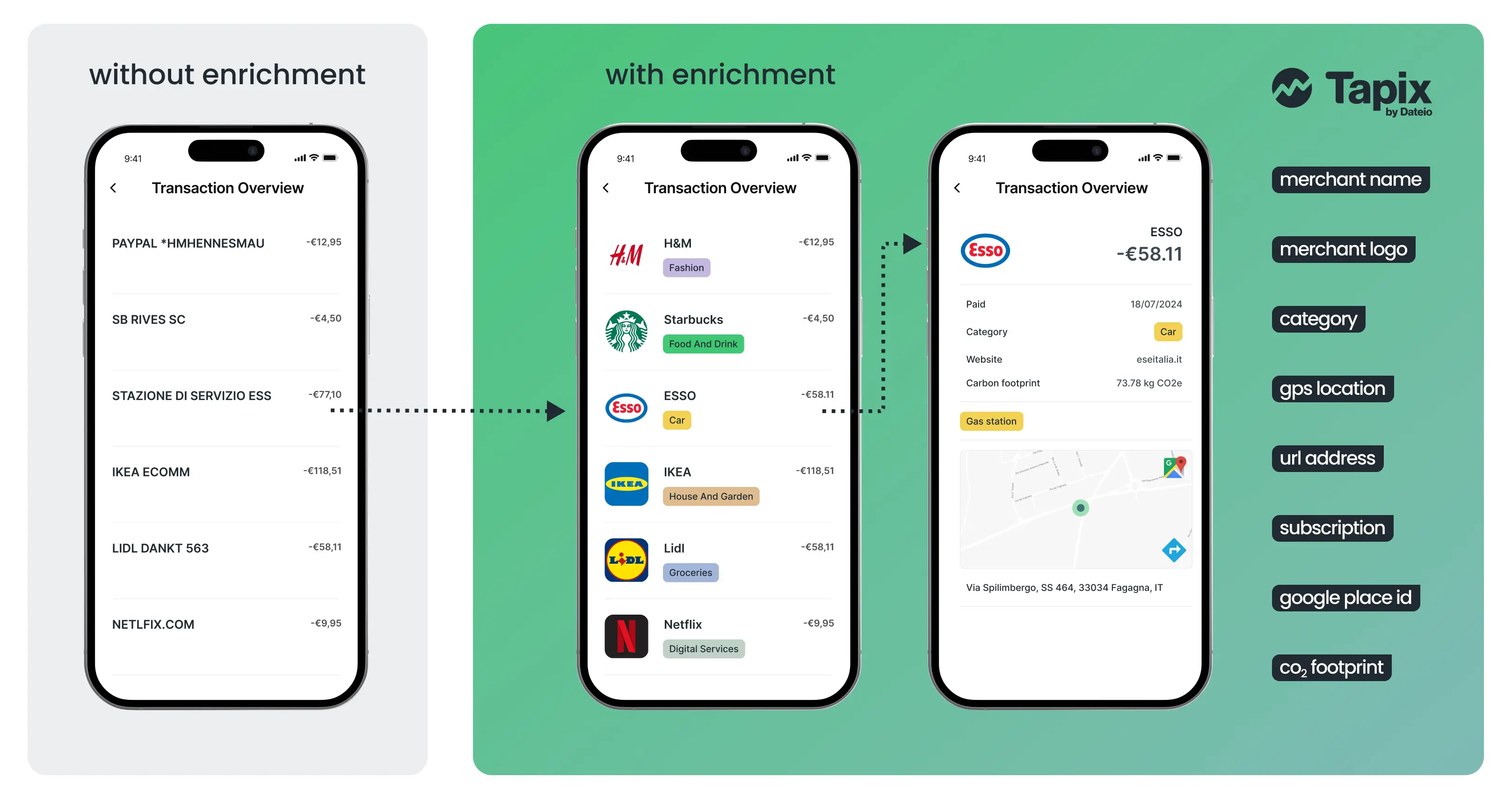
Let’s break down how each data point can be enriched to add maximum value.
Clean merchant name
The customer needs the name they know the merchant by, but usually gets the acquirer's descriptor or the registered company. Lead with the clean brand name in the feed and keep the original descriptor in the detail view, because it can hold payment references or verification codes that the customer or a support agent needs. Where the brand can't be identified with confidence, fall back to the original description. Tapix Merchant Name recognises 1.4m+ merchants.
Merchant logo
People scroll a transaction far more often than reading it, and a familiar logo settles a payment at a glance. When no logo exists, a category icon such as a coffee cup or a shopping bag keeps the list consistent. A wrong logo is worse than none: it tells the customer they paid a business they've never visited. Tapix Merchant Logo covers 130,000+ unique logos at 512x512 pixels, each manually proofed.
Store-level location
The brand tells the customer who they paid; the location tells them which visit it was. "Starbucks, Old Town Square, Prague" triggers a memory that "Starbucks" alone doesn't, and it helps customers spot a genuine double charge. This matters most abroad, where descriptors arrive in an unfamiliar language. The location needs to be the shop itself, not the merchant's headquarters. GPS Location and Google Places ID point to the exact store.
The real merchant behind a payment gateway
Payments routed through gateways, wallets and BNPL providers often show only the intermediary. "PayPal" or "Stripe" tells the customer how they paid, not what they bought. Identifying the merchant behind the payment gateway closes one of the most common sources of unrecognised charges.
Recurring payment labels
Forgotten subscriptions and free trials that roll into paid plans are a classic route to a dispute: the customer genuinely doesn't remember agreeing to the charge. A recurring label with frequency, next billing date and expected amount lets them see the charge coming and cancel instead of disputing. Recurring Payments Intelligence detects recurrence at transaction level, and our overview of subscription management solutions for banks shows the features built on it.
Merchant contact details and URL
Some disputes are really service complaints: the wrong size, a late delivery, a refund that hasn't arrived. A merchant phone number and website in the detail view give the customer a direct route to resolve it, which keeps the problem out of the chargeback process where it never belonged. See merchant contact info.
Categorisation
Category alone rarely stops a dispute, but it supports everything above. It adds context when a name is ambiguous, drives the fallback icon, and gives support agents and fraud models a cleaner view of spending patterns. MCC codes are too broad for this, as we explain in why MCC codes don't help much with payment categorisation. Tapix categorisation works with 25 categories and 530+ tags.
Accuracy matters more than coverage in a dispute
Three dimensions decide whether transaction details help: coverage (the share of transactions enriched for each data point), accuracy (how correct each data point is) and information richness (depth such as the shop inside a mall or the merchant behind a gateway). For dispute prevention, accuracy comes first.
A missing logo is a neutral outcome. A wrong merchant name actively convinces the customer that something is off, and that is exactly the moment they call the bank. A clear placeholder beats a confident mistake every time. Tapix enrichment runs at 99.99% accuracy, with fewer than one complaint per 6 million transactions.
Who does it right
Revolut and bunq both treat the transaction feed as a product. bunq uses enrichment for merchant names, logos, GPS locations and categories, and builds subscription overviews on top, as described in how bunq provides data-driven insights. Swisscard used enriched merchant data to meet AN4569, showing how one data layer serves the customer experience and the compliance team at once: read the Swisscard success story.
Prevention starts in the transaction feed
Every chargeback that begins with "I don't recognise this" was decided long before the dispute form opened. Banks that fix the feed reduce disputes, support calls and scheme exposure with one investment, and meet both card mandates in the process. The work is less about adding features than about making each line in the feed answer who, where and why. Tapix enriches that feed with the merchant name, logo, location, gateway and recurrence data a customer needs to recognise their own payments.
