In conversations with product owners at banks, one observation recurs: a subscription management describes very different things to different institutions. For one bank it means a screen listing Netflix and Spotify. For another it means a forecast of what will leave the account next month. For a third it means a button that stops a payment, and for a fourth a register of every merchant that holds the customer's card. While the term is shared, the intent behind it is not.
Subscription management resolves into four distinct solution: the list, the overview, the control layer, and the audit. Each answers a different bank motivation, and each draws on a different data source. This article examines all four, sets out what each is worth to the customer, and explains how to weigh them against one another before committing engineering effort.
If you need the wider framing of how recurring payments fit into a banking app, recurring payments in digital banking covers the cluster-level view.
Start with the bank motivation
Before selecting a solution, define what the institution is trying to achieve. In practice, the objective is usually one of the following:
- To act as a trusted personal advisor and financial planner, helping customers see and manage the commitments they have taken on.
- To become the customer's primary bank. Customers who can see all planned outgoings from one account have a stronger reason to route their recurring payments there and to hold sufficient balance to cover them, so more transactions flow through the bank's cards and higher balances remain on account.
- To reduce chargebacks and call centre costs, given that forgotten subscription payments are a leading source of complaints.
- To help customers secure their card and control who is able to charge it.
- To meet the Visa subscriptions mandate, which applies in selected markets.

The motivation determines the solution. A bank optimising for call centre volume requires something different from a bank optimising for primary-bank status, and both require something different from a bank treating subscription management purely as a compliance obligation. Establishing the motivation first prevents the common error of building a solution that does not serve the outcome the bank actually wants.
Subscriptions and recurring payments are different detection problems
The terminology matters more than it sounds. It determines whether you need a specific scheme field or a detection engine.

A subscription is a payment the customer does not initiate. They have given card or account details to a merchant, which charges a set amount at regular intervals - Netflix or Spotify on the card rail, an insurance plan or gym membership pulled monthly by SEPA direct debit on the account rail. Same principle either way: the merchant initiates, the amount is typically stable, and the service auto-renews until it is actively stopped.
A recurring payment is broader. It includes payments made on a regular pattern where the customer controls renewal - an annual transit pass, a motorway vignette, or a utility standing order. They look similar in transaction history but behave completely differently, and that difference determines how each type must be identified - which is where most subscription management projects succeed or fail.
The definitional groundwork on this sits in how subscription management and recurring payments drive customer value.
Solution one: the subscription list
Definition: a display of subscription payments that have already been billed.
Scope: card subscriptions only.
What it does: for each subscription, the list shows a clean merchant name and logo, the payment history behind it, and the date of the last payment. The customer opens a single screen and sees which digital subscriptions they are paying for, without scrolling through a statement.
Trade-offs: the list is a genuine but limited benefit. Because it covers only card subscriptions, and only those that have already charged, it does not present a complete picture of the customer's financial obligations. It also gives no visibility of when each payment will leave the account.
Motivation served: the Visa mandate - specifically the listing requirement, which this solution covers in part.
Solution two: the subscription overview
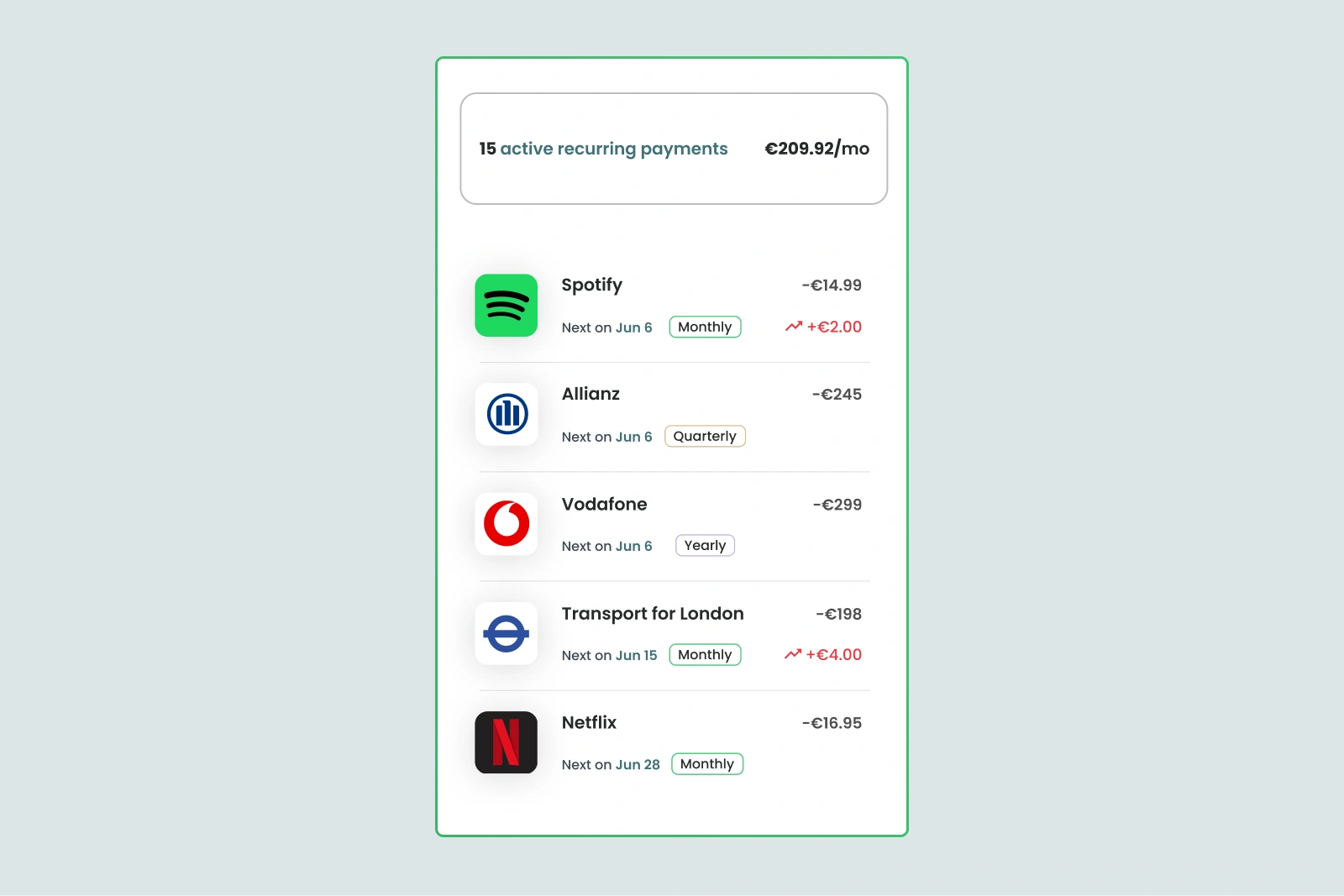
Definition: a comprehensive view of all subscriptions and recurring payments, combined with forecasting data.
Scope: ideally both subscriptions and recurring payments, across payment rails.
What it does: the overview brings together the full scope of recurring commitments like cards, SEPA direct debits, standing orders, or open banking data, and shows the customer what leaves their account and when. Three data points do the work: frequency, next billing date, and the type of the next amount, meaning whether it is fixed, variable, or estimated. On top of these sits a prediction of total monthly subscription spend, aggregated across cards, standing orders, and direct debits.
Trade-offs: the overview lets customers plan what will leave their account and when, and it supports an engagement layer on top of that - a known billing date is a reason to send a notification, and a reason for the customer to open the app when no transaction has prompted them. Presenting a payment in advance and in context is also the most direct lever available on friendly fraud. The same visibility underpins primary-bank status: a customer who can see every commitment in one place has a reason to route payments through that app and to hold enough balance to cover them. Cross-rail coverage is the demanding part of building this, and it is what Recurring Payments Intelligence is designed to provide.
Motivation served: financial planner, primary bank, chargeback reduction, and the Visa mandate listing requirement in part.
Solution three: subscription controls
Definition: an action layer allowing the customer to block, pause, cancel, or change a plan from within the app.
Scope: card subscriptions only, usually paired with a list or an overview, since the customer must be able to see a subscription before acting on it.
What it does: in practice, this is a block-merchant or cancel-subscription button inside the payment detail. The bank surfaces the control, the block itself is executed by the payment processor or the card scheme. The benefit is direct: the customer can stop a payment in the app rather than calling to file a chargeback.
Trade-offs: one point must be stated plainly, because Visa requires banks to state it. Blocking is not cancelling. A block declines the charge, but the customer's agreement with the merchant remains in force. The customer can still owe money to the merchant they have blocked, and in some cases continue to accumulate charges they are unaware of. A blocked payment is also still attempted, so any decline fees attached to failed payments continue to apply. Cancellation and plan changes, meanwhile, depend on direct integrations with merchants, which are realistically limited to a small number of global merchants and can therefore produce an inconsistent, confusing experience. Good design does not remove this contractual reality, but it addresses it honestly.
Motivation served: the Visa mandate, specifically the blocking requirement, together with chargeback reduction.
Solution four: the subscription audit
Definition: a list of the merchants that hold the customer's card credential.
Scope: card subscriptions plus unscheduled card-on-file relationships.
What it does: the audit answers a different question from the first three solutions. It addresses not what is leaving the account, but who is able to reach into it. For each merchant, it shows that the card credential is held, the state of the token, whether active, suspended, or expired, and the date the merchant last charged the stored card. Crucially, it includes the merchants the customer has forgotten: the e-shop used once two years ago, the retailer's one-click checkout, the wallet token issued and never revisited, and even merchants where only a free trial was taken and no payment was ever made.
Trade-offs: the value here is preventive. Customers stop leaving card credentials scattered across services they no longer use, they identify risky relationships early, and they gain a sense of control over their card's digital footprint that a payment list cannot offer. The limitation is that the audit carries no financial context: it shows that a merchant is able to charge the card, but not when or how much. It is a distinct product built on a distinct data source. The token-status data and card-on-file inventory themselves require integration with card-scheme token vaults (Visa VTS and Mastercard MDES) and the bank's payment processor - scheme and processor capabilities, not enrichment data.
Motivation served: card security.
How each solution is identified, and how complex it is to build
Because the four soltuions draw on different data, they also differ in how the underlying activity must be identified.
Subscriptions can, in theory, be identified from a specific parameter in the data message supplied by Visa or Mastercard. In practice, banks frequently do not have that field available, and analysis indicates it is not the most reliable indicator even when present. Recurring payments are even harder, because they rarely carry a single specific field and must instead be established by pattern, combining intervals, amount stability, merchant behaviour, and the customer's own history.
Two further distinctions matter here. The first is transaction-level identification. A recurring YouTube membership and a one-off payment to an individual YouTube channel arrive from the same merchant, so merchant name alone cannot separate them; the recurring instance must be identified at the level of the individual transaction. The second is the difference between recurring payment detection and card-on-file detection. Recurring payment detection reads patterns in the transaction feed, so it can predict future charges only for merchants that have actually charged the card. Card-on-file detection reads the network token vaults and shows every merchant holding the credential, including those that have never billed.
With those distinctions in place, the two questions that rank the solutions for any given bank can be applied.
How to weigh the four subscription management solution
The first question is how much a solution helps the customer manage their finances. This is its customer value. A list tells customers something they could largely work out for themselves, an overview tells them something they could not.
The second question is what the solution takes to build. This is its technical complexity, which ranges from simple parameter logic applied to data the bank already receives, through to the combination of multiple external parties.
Applied to the four solutions, the assessment is as follows:
The complexity rating reflects the logic once the data is available, which is genuinely simple. The value rating is marked questionable not because card security does not matter, but because the capability is frequently misunderstood by customers, who expect a subscription feature and receive something broader that is difficult to explain in an app screen.
From what we see across bank conversations, the combination that works is the overview paired with either blocking or a direct route to the merchant's cancellation page. That covers what customers actually ask for: know what is coming, and be able to do something about it.
What separates a subscription feature customers trust from one they open once is whether the detection underneath it is right: whether the yearly subscription was caught, whether the standing order was included in the committed-spend figure, whether the one-off payment to a subscription merchant was correctly excluded.
