Affordability comes down to one number a lender needs to evidence: what's left after every expense is paid. That's an account information job, start to finish, and two open banking roles matter for different reasons. An AISP reads the transaction picture that makes affordability calculable. A PISP moves money once a decision is made, but it plays no part in working out whether someone can afford anything. The two are relevant to a lender at different points, and adoption is now tilting from the reading role toward the acting one.
The two roles
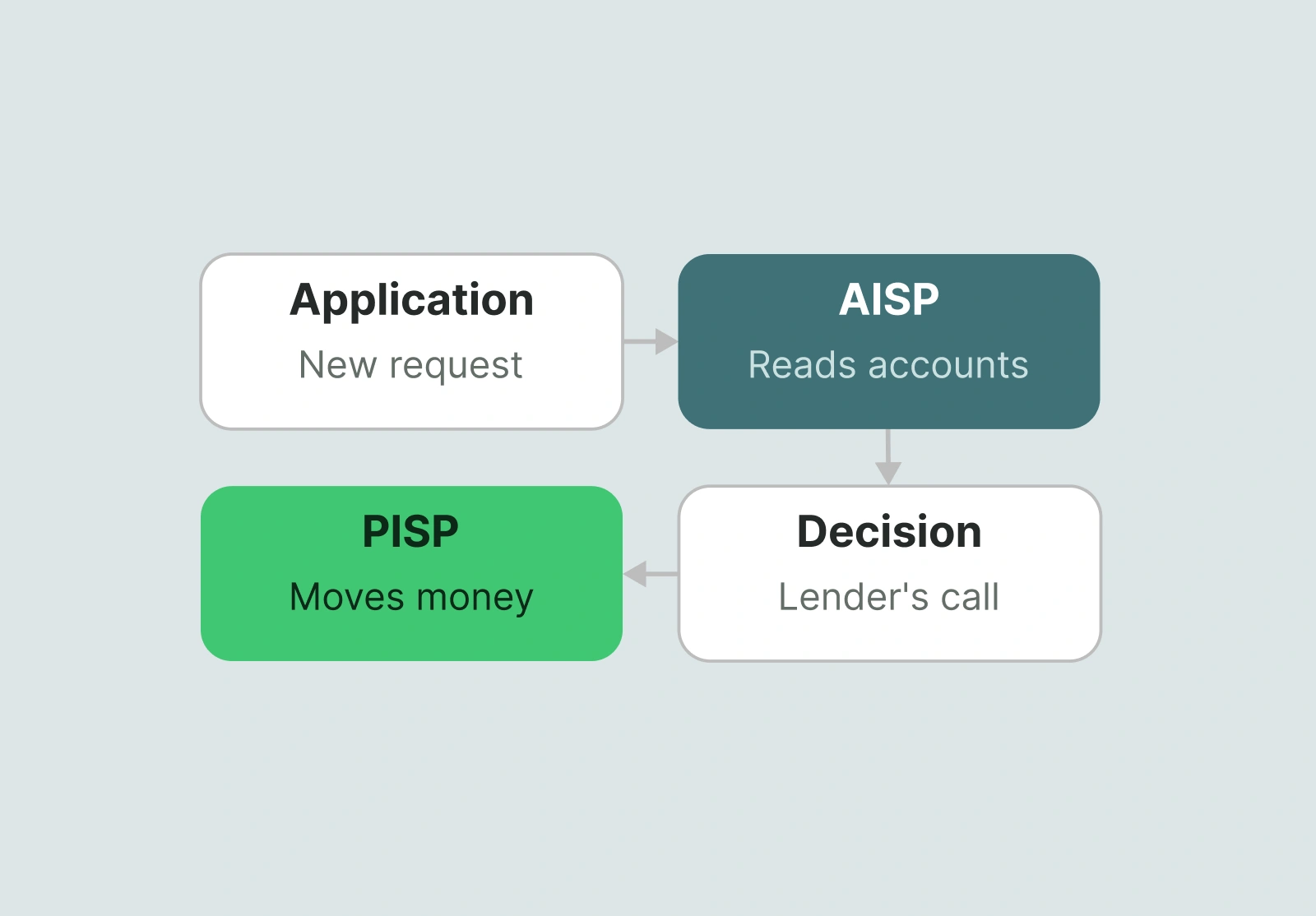
Both roles matter, but not for the same reason. An AISP is a regulated provider that can access an applicant's bank account data (with consent), so a lender can make a creditworthiness assessment. A PISP is how money moves once decisions are made. Keeping those jobs separate is the whole point of the split.
An AISP (Account Information Service Provider) reads account data with the customer's consent: income, spending, recurring commitments, and the transaction history behind them. It sees the raw payments picture (not necessarily legible for company underwriting) but never touches the money.
A PISP (Payment Initiation Service Provider) does the opposite. It initiates a payment on the customer's instruction (and that customer can be the lender itself, for example disbursing the loan or collecting a repayment through a PISP) moving money from A to B, with nothing to do with analysing spend or deciding what's affordable.
Lenders preparing for CCD2 care about the reading role because that's where a defensible affordability decision is built, and about the initiation role separately, as a way to move money without a card rail.
Why AISP is where affordability is decided
Credit bureaus are good at one thing: showing whether someone is already indebted. What they don't show is either side of the everyday ledger, income as it lands and expenses as they're spent, month to month. And that everyday flow, not the record of existing debt, is the harder half of the affordability question.
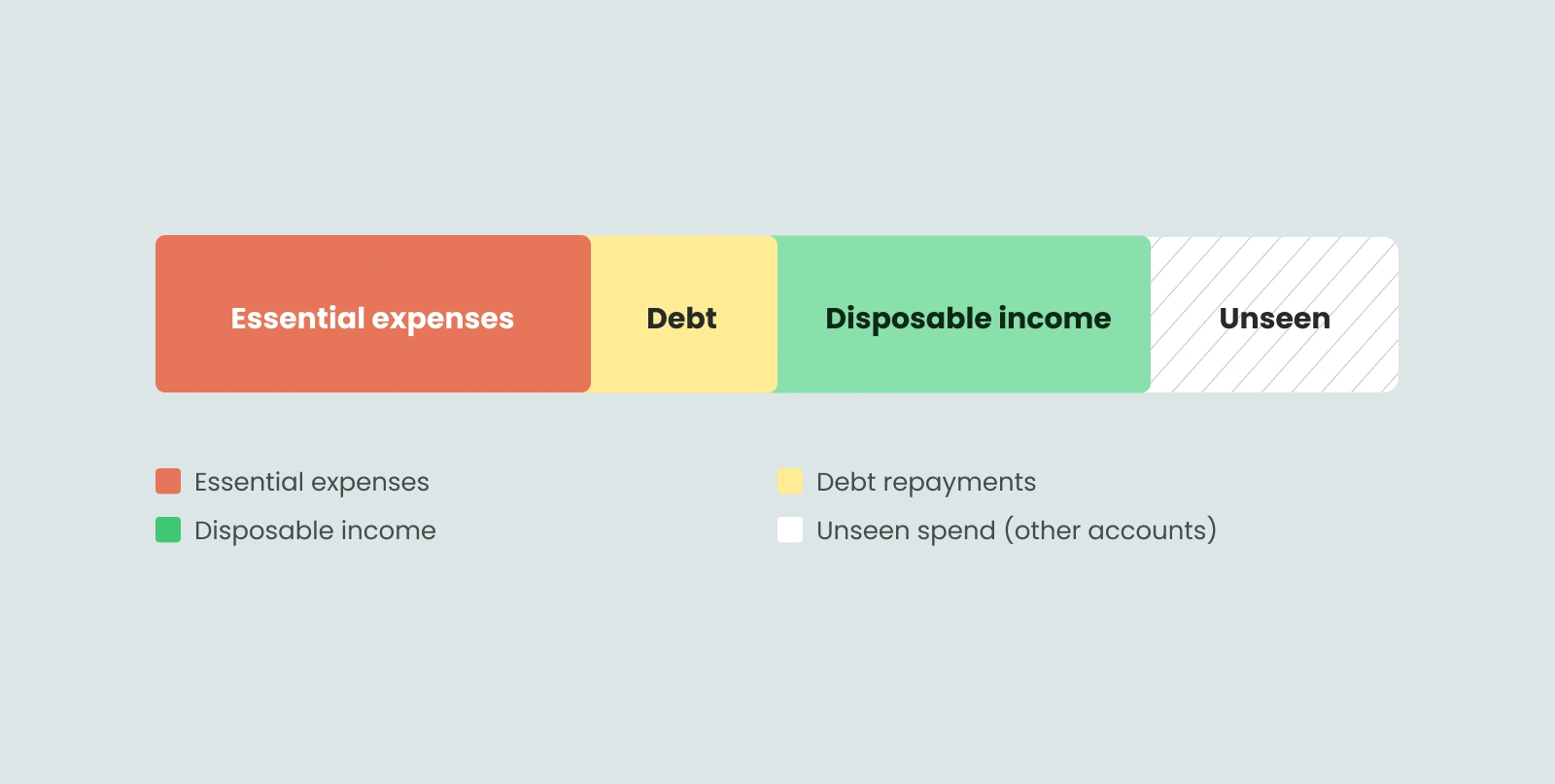
Affordability is income minus all expenses, debt repayments included. That difference is disposable income, and it's the number a lender needs to evidence a decision. Bureaus don't hold it. AISP data reads the real transactions that make disposable income calculable, giving a direct view of income as it arrives and outgoings as they happen. It also surfaces spending that services existing debt, though it's worth pointing out that what a lender sees is the repayments and commitments visible in the connected accounts, not a guaranteed, complete register of every liability the borrower holds elsewhere.
There's a tempting shortcut. A lender looking at its own customer already holds that customer's transaction history, so the reasoning goes: "we already have their data, we don't need open banking." That only applies for account-holding banks, and only when the customer banks nowhere else. A bank that keeps someone's sole account genuinely sees a complete expense picture from its own feed. A provider like Partners, which does hold client accounts, can lean on that visibility. But most lenders can't: firms like HomeCredit have no customer account by default, so they hold no transaction feed of their own to fall back on. For them, open banking is the only way in.
But there are two things to focus on here. First, sole-account relationships are the exception. Once a customer spends across several institutions, the lender's own feed captures a fraction of their outgoings, and treating that fraction as complete is simply wrong. Second, plenty of the people a lender most wants to assess aren't its customers at all. A BNPL provider or a lender underwriting a new applicant has no internal feed to fall back on. Connected-account data via an AISP is what lets them assess someone they've never banked, on the same footing as an existing customer, and win business that would otherwise go to whoever already holds the account.
AISP coverage has a built-in integrity check
Connected-account data doesn't just make disposable income calculable. It also carries a signal for when the picture is still incomplete.
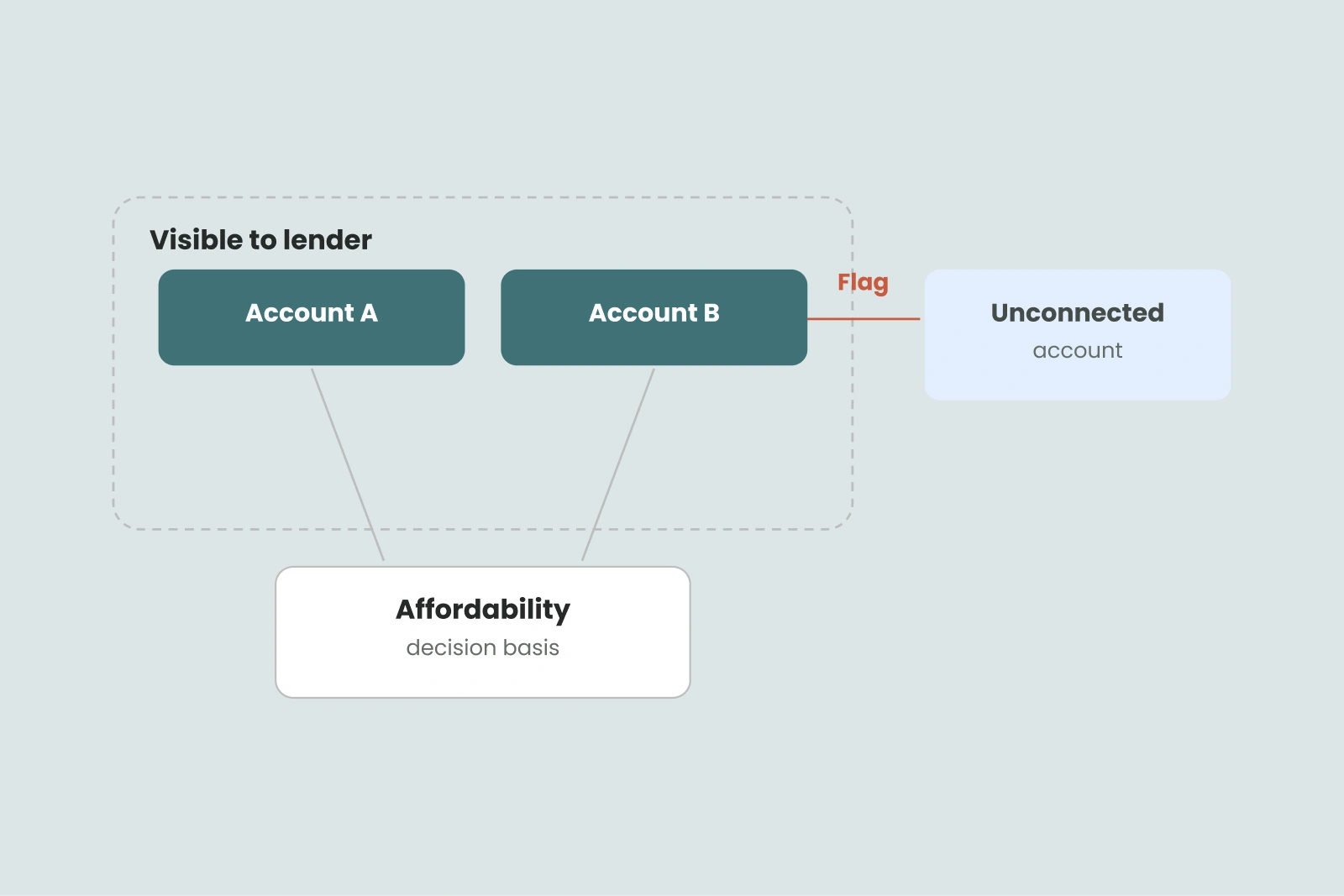
If a lender reads a customer's connected accounts and sees regular transfers heading to an account under the same holder that isn't connected, that's a flag: money is leaving the visible picture, and the expense view has a gap. Rather than silently treating partial data as complete, the system surfaces the incompleteness, which is exactly what a defensible affordability decision needs.
The depth of the signal matters more than raw coverage percentage. Take an anonymised example: a transaction identified as a gambling merchant through its counterparty details, even where the raw descriptor gave nothing away. That kind of category-level identification, drawn from enriched transaction data, changes an affordability read in a way that "we enriched 84% of transactions" never could. What you can identify beats how much you can count.
Where PISP comes in: acting on the decision
The initiation role sits entirely apart from the affordability question. Once a decision has been made, on whatever basis, a PISP is how the resulting money movement happens.
A PISP initiates the payments a lending relationship generates: moving an approved loan, collecting a repayment, running a scheduled instalment, all on the customer's instruction and without a card rail in between. It doesn't read the affordability picture and doesn't need to. Its job is execution.
That's why the two roles belong in separate boxes. The AISP asks "can this person afford it, and can I evidence that." The PISP says "now move the money." Useful to a lender at different moments, and best not conflated.
The market is shifting from reading to acting
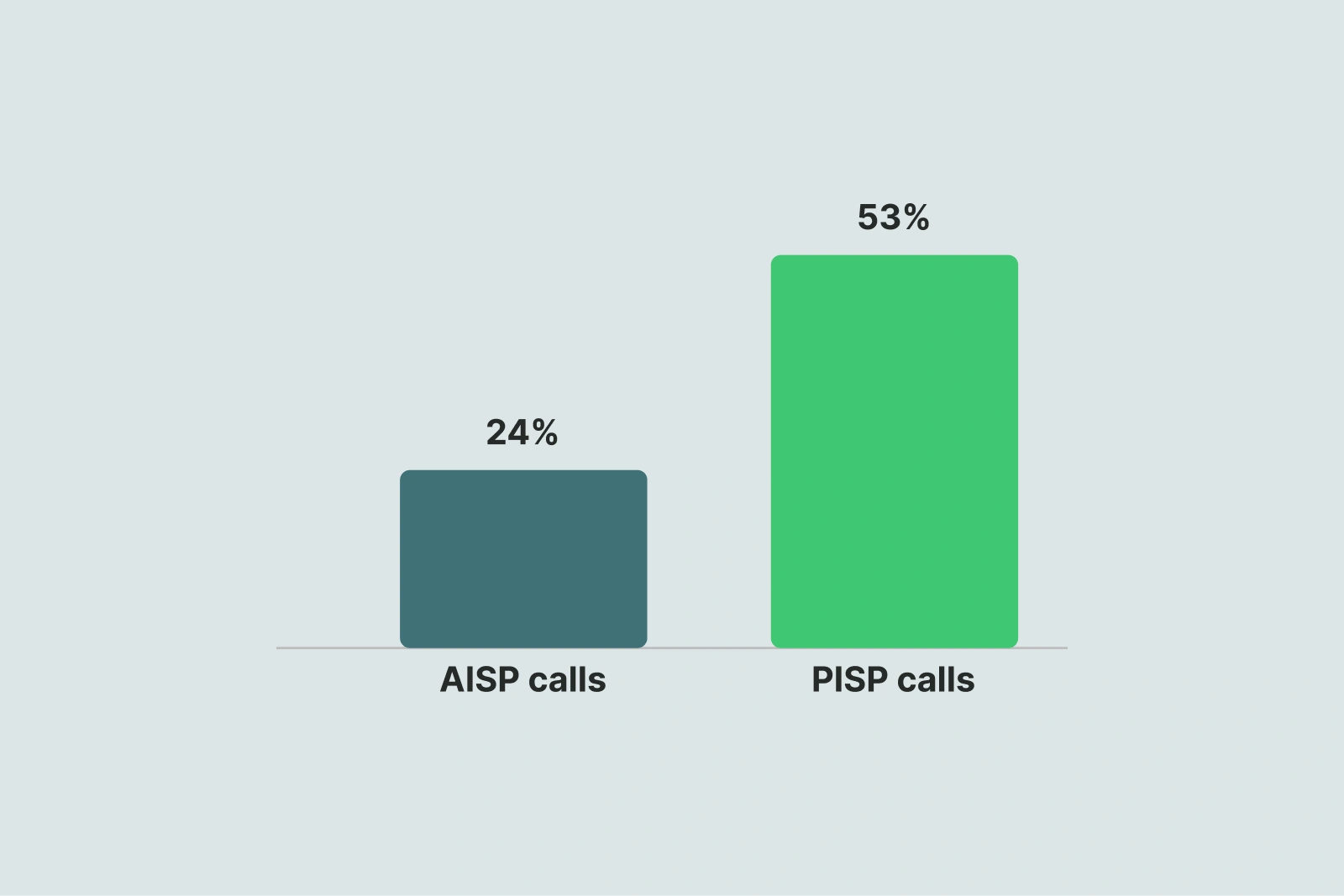
In 2025, total open banking API volume reached 24 billion calls, up 27% year on year, according to Open Banking Limited. Payment initiation (PIS) calls grew 53% year on year, more than double the growth in account information (AIS) calls at 24%. Reading data is still the larger base, but acting on it is where the acceleration is.
Open banking is no longer used mostly to pull data in and look at it. Initiation is growing fast as a distinct capability. For a lender, that means both roles are worth understanding on their own terms, even though only one of them touches affordability. For teams working the CCD2 roadmap, reading the picture accurately, and knowing when it's incomplete, is what turns an affordability model from something you run into something you can defend.
