Recurring payments are moving from cards to bank accounts, and the rules that make card payments readable are not moving with them. Three in four people in Central and Eastern Europe have at some point failed to recognise a payment on their statement, and one in three call their bank straight away. That call often ends in a dispute or a cancelled card.
The card schemes now require issuers to display card payments clearly. Mastercard asks for the merchant’s name, logo, address, and contact details. Visa asks for the same minus the logo, and adds an in-app option to stop recurring payments to a specific merchant. But payments are shifting to account-to-account schemes such as Wero, BLIK and Bizum, where equivalent rules are still being written and the bank receives less data about the merchant. Recognising the payment and explaining it to the customer remains the bank’s job.
Did you know? In Czechia, the average customer banks with 2.8 institutions, according to Raiffeisenbank CEO Igor Vida.
Why banks are building alternatives to cards
- Dependency. According to the ECB, international card schemes process around two-thirds of card payments in the euro area, and 13 of the 21 euro area countries have no domestic card scheme.
- Fees. The UK Payment Systems Regulator found that Visa and Mastercard raised scheme and processing fees by at least 25% in real terms between 2017 and 2023. Banks don’t pay these on account-to-account payments, though they do give up interchange, which the EU caps at 0.2% for debit cards.
- Infrastructure. Since 2025, euro area banks have had to send and receive instant payments and may not charge more for them than for a standard transfer. Banks in non-euro EU countries follow for euro payments in 2027.
So banks are building their own account-to-account payments. Wero has more than 50 million registered users and has supported subscription payments since September 2026. Poland’s BLIK processed 2.9 billion transactions in 2025, and nine banks offer recurring BLIK payments. In Czechia, Air Bank, Fio banka, mBank and MONETA back Cvak which Lidl began rolling out in August 2026.
Cards still lead by volume, but the data banks send us for enrichment shows the opposite picture. Transfers now clearly outnumber card payments, BLIK and Spain’s Bizum keep growing, and the first Wero samples are arriving. At the same time, banks are asking for more merchant detail: phone numbers, websites and locations.
The same shift is visible at the ATM. Contactless withdrawals by phone use a digital card in Apple Pay or Google Pay, so they still run over the card network. Some banks, such as Czechia’s Česká spořitelna since 2022, offer QR-code withdrawals from the banking app instead. These go straight from the account with no card involved, and the bank pays the card scheme nothing.
Who sets the rules for recurring payments
For cards, the schemes set the rules. They define dispute timelines and procedures and fine merchants with high dispute ratios. Visa, for example, requires merchants to notify customers seven days before a free trial ends and to make cancellation easy. Since 2023, Mastercard has required European issuers to show the merchant’s name, logo, address and contact details in-app. Visa requires the same, without the logo, from January 2027. Since April 2026, Visa has also required banks in 13 European markets to identify recurring card payments and let customers stop them for a specific merchant in-app. The customer no longer has to cancel the whole card.
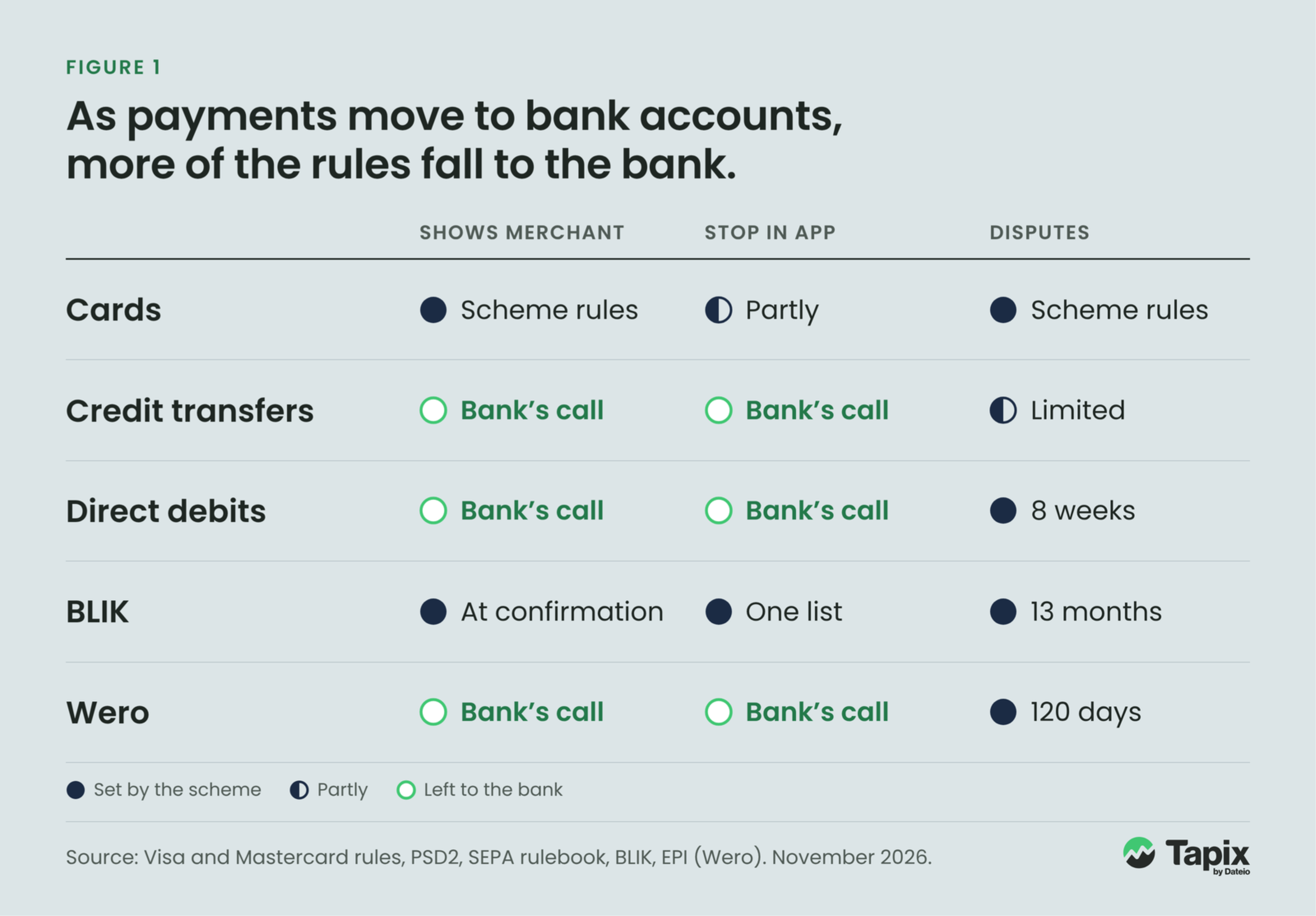
For account-to-account payments, this layer is missing or still forming. EPI writes the rules for Wero: customers can dispute a payment within 120 days, and their own bank decides. EPI hasn’t yet published rules for subscriptions or for how payments should be displayed. A standard credit transfer has no merchant dispute process at all. Under PSD2, payers are protected against unauthorised and incorrectly executed payments, not against a merchant who keeps charging for a service they no longer want. Direct debits are the exception: SEPA rules give the payer an eight-week refund window.
BLIK shows where this is heading. Customers confirm a recurring BLIK payment in their banking app and see the merchant’s name and website as they do. They can then find all recurring payments in one list and switch any of them off. Cancelling the service with the merchant is a separate step, just as with Visa. And customers can dispute a payment for up to 13 months, including because they don’t recognise it.
Brazil is moving the same way. The central bank set 16 June 2025 as the launch date for Pix Automático, its recurring payments feature, and customers authorise, control and cancel these debits directly in their banking app. BLIK and Pix have brought to account-to-account payments the controls that Visa and Mastercard enforce for cards. Expect similar requirements to follow for other schemes.
Why customers don’t recognise the payment
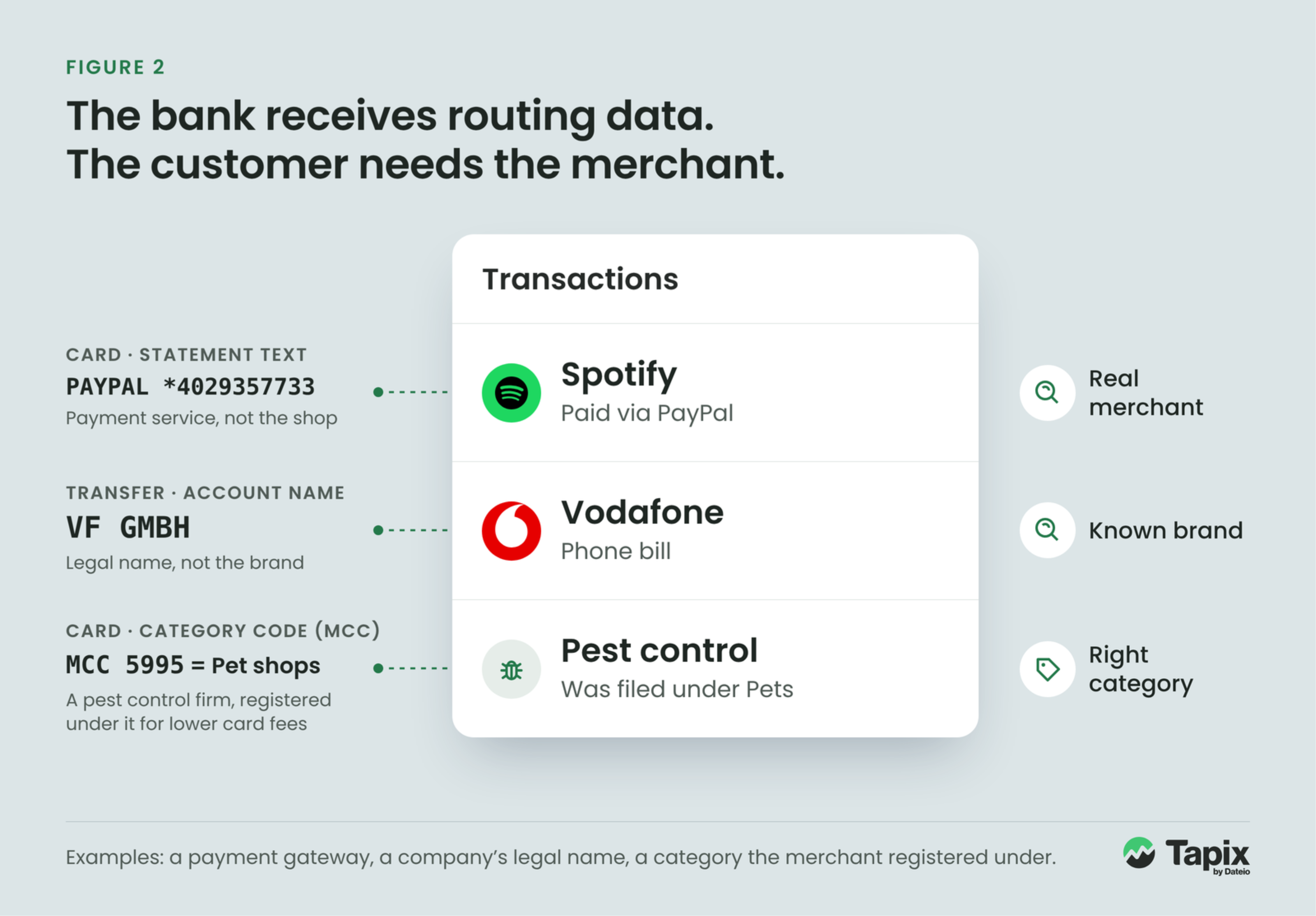
A payment doesn’t carry the brand the customer knows from the shop. It carries whatever the banks need to route the money correctly, and that is often misleading. When someone pays for lunch through a pay-at-table app such as Czechia’s Qerko, the app collects the money and forwards it to the restaurant later. The statement shows the app, and the restaurant doesn’t appear in the payment at all. The lunch also lands in whatever category the app is registered under. Banks patch this by hand, for example by moving every payment through that app into restaurants. But there are thousands of such exceptions.
The merchant category code helps less than it seems. The card schemes define the code list, but the acquirer, meaning the bank or company that lets the merchant accept cards, assigns the code. Once assigned, it rarely changes. In Tapix data, a category based on the MCC alone matched reality for only 63% of payments. Part of the gap is deliberate. Codes on high-risk lists carry higher fees, so merchants avoid them, which is how a pest control company ends up registered as a pet shop.
For account-to-account payments, the bank mostly has the payee’s account number and account name. That name is the legal entity, which often differs from the brand: a transfer to a German account named “VF GMBH” is a Vodafone payment. Some fields are also filled in by the payer. A transfer referenced “Netflix” may be half a shared subscription sent to a friend. The bank knows more about the payment than the customer sees on the statement, but its own merchant data is incomplete and inconsistent too.
How transaction enrichment helps
Turning that raw record into a merchant and category the customer recognises is called transaction enrichment. The system cleans the text, identifies any intermediary such as a payment gateway, and looks up the actual merchant in a database. It returns the brand name and logo, one of 25 categories plus 530+ detailed tags, the shop’s address and GPS location, its website and a Google Places reference. For recurring payments, it adds how often the payment repeats and when the next one is due.
Transfers are enriched from the account number. Companies that bill regularly, such as utilities, insurers and telecoms, publish their account numbers on their websites and invoices. So transfers can be enriched, but there are fewer reference points to work from. Neural networks do most of this work. Where they fall short, people with local knowledge step in, for example in Greece or Arabic-speaking markets, where merchants write in a different script.
Learn more about the difference between data enrichment and data cleansing.
That’s why most banks don’t build enrichment themselves. At Tapix, we enrich payments for 90+ banks and fintechs worldwide, including Revolut, Société Générale, UniCredit Bank, Raiffeisen Bank, Erste and bunq. Our data reaches 183m+ people through their banks’ and fintechs’ apps. We enrich 4bn+ transactions every month, against a database of 4.2m+ merchants and other payees. Accuracy is what matters here, because a wrongly matched merchant triggers the same dispute as an unrecognised payment.
For subscriptions, history matters as well. Services that sell only subscriptions, such as Netflix, can be identified from the very first payment, so even for a new customer. Where people also buy one-off, as with Apple, a subscription usually becomes visible only from the second payment.
Recurring payments look different in every market
Subscriptions are only part of the picture. People also pay rent, loan instalments, annual transit passes and motorway vignettes they renew themselves each year. When a bank recognises these, it can tell the customer in advance when the next charge is due, giving them time to cancel before the money leaves.
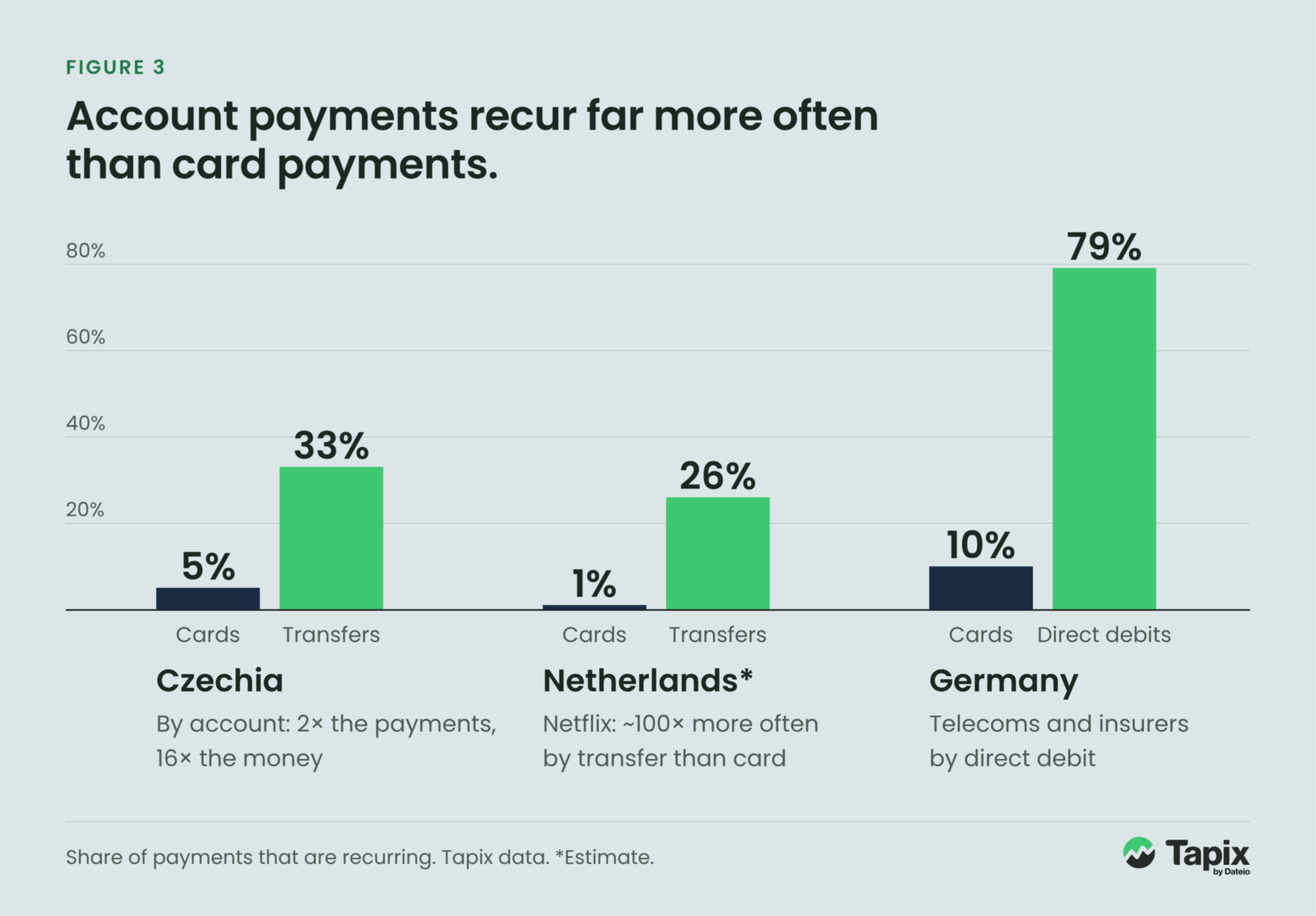
How many recurring payments run over cards depends on the market’s payment habits. Cards dominate in Czechia, the Dutch mostly pay by transfer, and Germans by direct debit. Here is the share of recurring payments among card and account payments in Tapix data from three markets:
- Czechia: 5% of card payments and 33% of transfers are recurring. Twice as many recurring payments leave by account as by card, carrying 16 times the money.
- The Netherlands: By our estimate, 1% of card payments and 26% of transfers. People there pay Netflix by transfer roughly a hundred times more often than by card.
- Germany: 10% of card payments and 79% of direct debits. Germans use cards mainly for digital services such as Apple, Google Play, Netflix and Spotify, and direct debit for telecoms, insurers and Deutsche Bahn.
Some transfer recipients aren’t in any merchant database: a homeowners’ association collecting rent, a sports club, a membership fee. We track around 40,000 such accounts receiving recurring payments. Even without a known merchant, the recurrence itself can still be detected.
Everything rests on data quality
Merchant data powers a long list of banking app features: subscription overviews, spending charts by category, expense analysis, carbon footprint estimates and the AI assistant that tells a customer how much they spent on food. When the bank doesn’t know the merchant, none of them work properly. And account-to-account payments, the growing share, say the least about who the merchant is.
An unrecognised payment also costs money. The customer asks what it is, calls the helpline or disputes it outright. In the US, McKinsey estimates the cost per dispute to financial institutions at anywhere from $10 to $50. A cancelled card adds the cost of a replacement and the spending that moves to another bank. These costs are avoidable.
For IT and product teams, that means treating merchant data as infrastructure. A bank should know what share of payments its customers can recognise in the app, measured separately for cards and account-to-account payments, and it should keep that data current.
