Across Europe, many merchants sell distinct and varied subscription products. That is how the subscription economy appears in bank transaction data: dense, fragmented, and structurally difficult to read. The brand-name surface looks tidy, with Netflix, Spotify and Apple at the front. Underneath, every merchant runs roughly six pricing variations, on average, across different amounts, billing cycles, currencies and payment paths.
Recurring subscription payments have become one of the most predictable patterns in consumer banking data across the continent: not the largest spending category, but among the most regular. Around half of European cardholders pay at least one active subscription. Yet most banks still can't reliably detect or classify these transactions, which means the steadiest signal in their data goes unread, at the precise moment regulators are requiring them to read it.
"Subscriptions have become a new layer of our everyday spending," says Ivan Dovica, CEO of Tapix. "The problem is that the money leaves the account automatically, which turns these charges into invisible items for many people, and they easily lose track of how much they actually pay each month. That is exactly why the need for banks to categorise these transactions clearly and show them understandably in their apps keeps growing."
This article shows how large the subscription economy is across Europe, where the money flows, why standard merchant-level identification breaks down, and what the regulators now require
The subscription economy is denser than the brand names suggest
The average subscription merchant in Europe doesn't sell one product. It sells a spread of variations, and each variation has to be matched on its own terms.
This is what makes reliable detection hard. Recognising the merchant name tells you almost nothing about whether a given charge is a subscription, which plan it belongs to, or how often it recurs. To answer those questions you have to match on merchant, amount, frequency, and payment path together. That holds whether you're looking at Czech, Hungarian, Polish, or Romanian data. It is why effective recurring payments intelligence operates at the pricing-rule level rather than the merchant level.
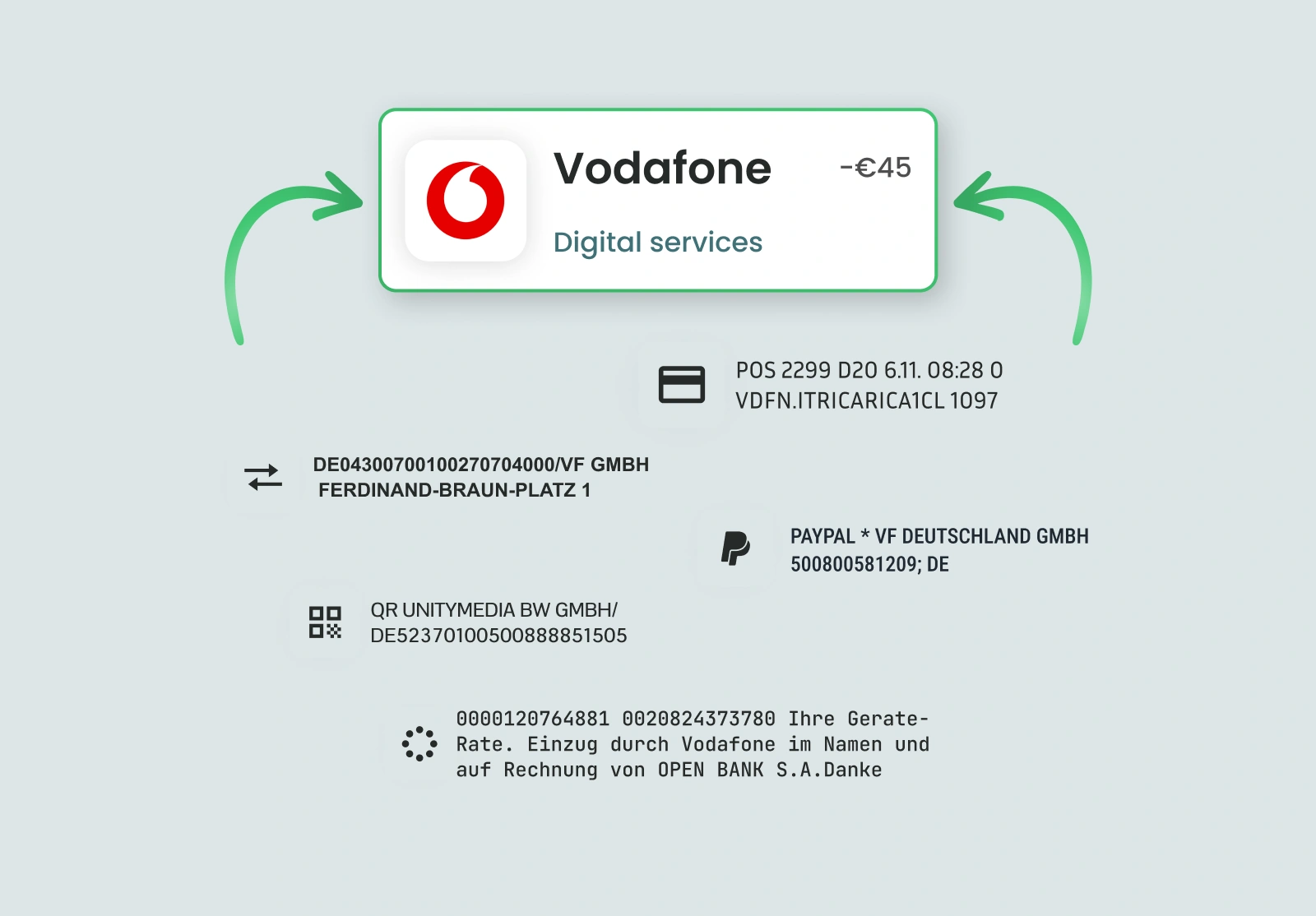
A second pattern compounds the problem: around 25% of subscription transactions across the region route through a payment gateway - Google, PayPal, Barion, GoPay, CRV, SimpleP. The user is paying Netflix; the description in the bank data says PAYPAL *NETFLIX COM. Without gateway resolution, one in four subscriptions is misattributed at the source.
Where the money flows: digital services dominate, bills carry the value
Categorise subscription transactions across Europe and a clear path appears. Digital services account for 50.1% of subscription transactions and 51.2% of subscription spend. Freetime (streaming, gaming, press) accounts for 31.2% of transactions and 23.1% of spend. Bills and household sit at 9.5% of transactions but 20.3% of spend, reflecting the small number of high-value recurring charges that flow through energy, telco and internet. The long tail, covering travel, professional services, financial services, food and drink, consumer goods and electronics, together makes up the remaining 8%.
The two top categories behave very differently. Freetime is high frequency, low ticket: a typical Spotify charge. Bills and household is low frequency, high ticket: a typical energy bill. A subscription product that only reflects category totals will give the same answer to two very different questions, which is why category-level analysis hits a ceiling fast.
Within categories, the merchant ranking is striking. Apple alone accounts for 28% of all subscription transactions across the dataset and 13.5% of subscription spend. Google Play, Netflix and Spotify round out the top four by transaction count. By spend, the picture moves in a different direction: Adobe, Microsoft, OpenAI and Sky appear only on the value ranking, with fewer charges but larger amounts, often annual. These are the subscriptions most likely to be forgotten by users and most likely to generate a dispute when they renew. Local players matter too. In the Czech market, the home-grown streaming service Voyo ranks fifth by transaction count, ahead of global names like Disney+ and PlayStation, a signal invisible without market-level data. Spend rankings can also surface categories that barely register on transaction count: in some markets, insurers such as Allianz and Generali appear among the top ten by value.
Who pays subscriptions across Europe
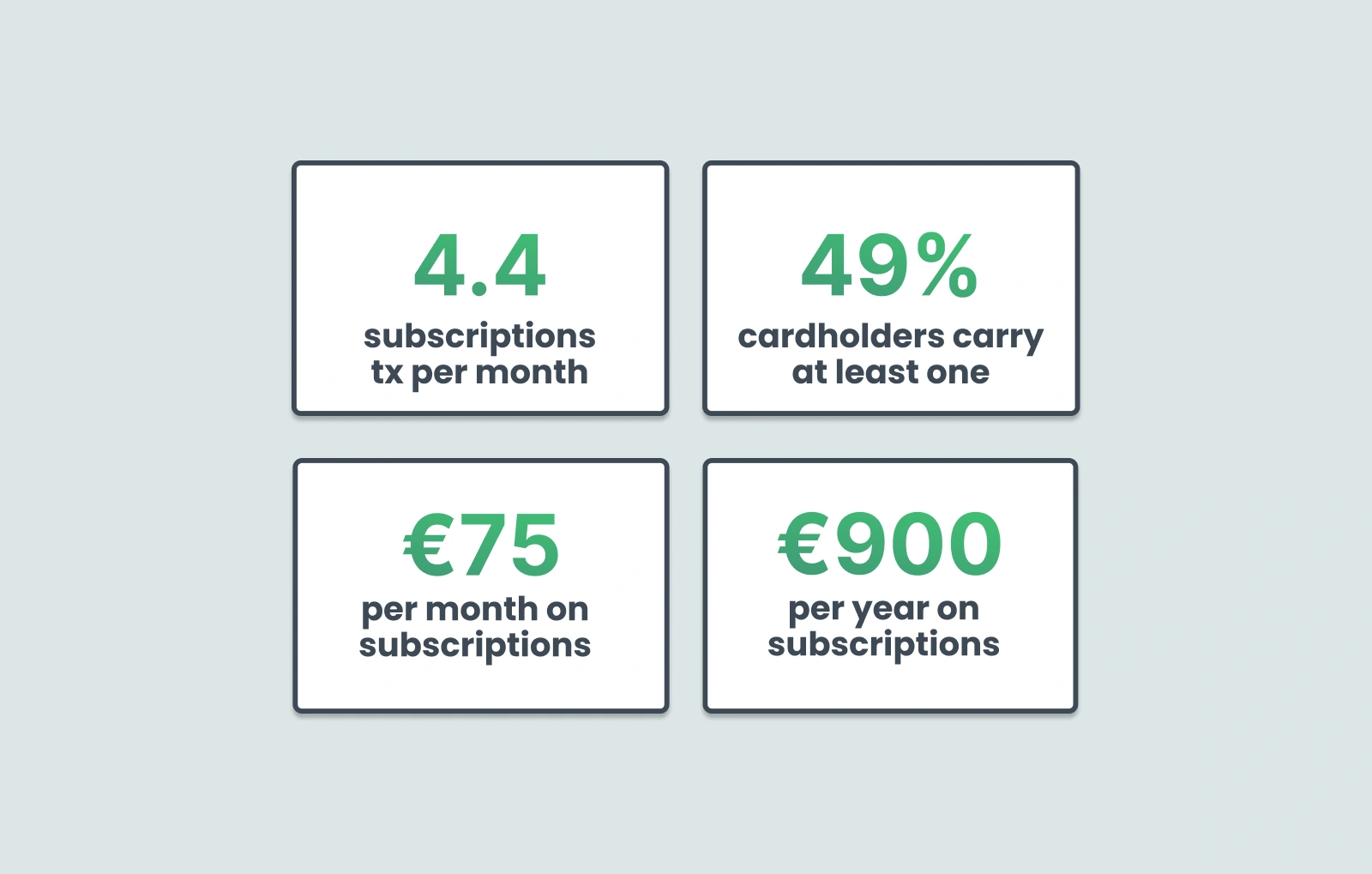
Across the region, around 49% of cardholders carry at least one active subscription. Roughly 32% manage two or more at the same time, 21% run three or more, and 15% run four or more. Subscriptions are now a standard line in most household budgets.
National averages still differ in ways that matter for spend. A typical European cardholder makes around 4.4 subscription transactions a month, spending roughly €75 per month and around €900 per year, with subscriptions making up around 7% of all card transactions. But the average price of a single subscription varies by market: around €16.50 across Central Europe, against roughly €14 in the Czech Republic, where cardholders spend about 40% less on subscriptions than the regional norm. The headline figure is a range the continent operates within, not a single number.
The detection problem: why this data is hard to extract
Those numbers look clean in a chart. In raw transaction data, they aren't.
Consider Disney+ in a single market, Hungary. The same merchant shows up across six distinct description formats in bank data, with annual charges at 24,900 HUF, monthly charges at 4,890 HUF, monthly charges at 2,990 HUF, and routes via PayPal and CRV that change the description string entirely. Same merchant. Same market. Different amounts, different payment paths, different descriptions. Which are subscriptions? Which plan? Monthly or annual? The merchant name alone answers none of these. The same pattern repeats for every major provider across every market.
Grocery delivery shows the other half of the problem. Rohlík, the Czech online supermarket, records subscription charges at 199 CZK monthly and 1,999 CZK annually, alongside ad-hoc grocery payments at 1,063.78 CZK and 2,312.18 CZK at the same merchant. Subscription versus one-off, monthly versus annual, all under near-identical description strings. The merchant names change from market to market (TFL in London, BudapestGO and BKK in Hungary, Rohlík in Prague) but the classification problem is the same shape everywhere.
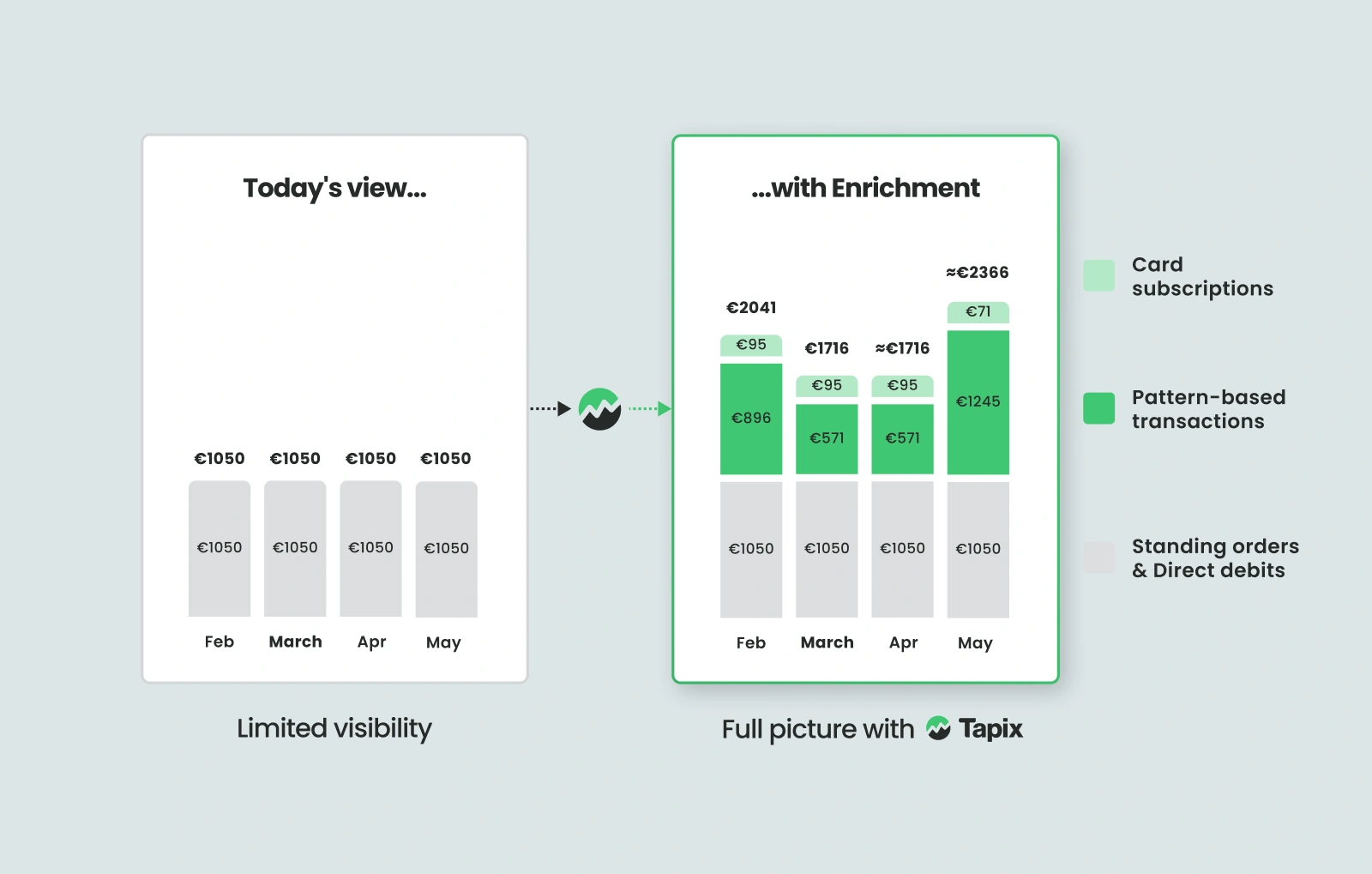
The conclusion is operational. Reliable subscription classification requires matching at the pricing-rule level: merchant plus amount plus frequency plus payment path. That is what the 15,000+ pricing rules in the Tapix dataset represent, and why coverage at this level is what turns dense data into something a bank can actually use. Merchant-level transaction categorisation is a starting point for the subscription economy.
The fintech versus traditional bank gap
The clearest divide in the data is between bank types. Subscriptions make up 10–15% of all transactions for customers of traditional banks, and 30–40% for customers of fintechs and neobanks. Fintech customers generate four to six times more subscription activity as a share of total spend.
That gap isn't because fintechs attract subscription-heavy people. It's because fintech accounts function as primary payment instruments for digital spending. In markets where cash still carries weight, consumers often open a neobank account specifically to manage digital subscriptions, then route that spending through it. Subscription management has quietly become a core function of modern banking.
The regulatory clock: from a Visa mandate to a European standard
From April 2026, Visa Core Rules require card issuers in selected European markets to offer subscription management in their digital banking channels. Cardholders must be able to view enriched transaction details, see all active subscriptions linked to their card, and cancel or pause them directly in the app. Several digital banks already work this way, among them Revolut, bunq, Plum, Up and Vivid.
Learn more about the mandates in our comparison.
A further Visa requirement is scheduled to follow from January 2027. Card issuers in Belgium, the Czech Republic, France, Croatia, Italy, Ireland, Luxembourg, Hungary, Poland, Romania, Slovakia, Slovenia and the United Kingdom will have to make extended merchant details available in digital banking, including the merchant's business name, address, phone number and website. Mastercard introduced comparable conditions back in 2023.
Clear payments are gradually becoming a standard that both customers and the card networks expect from banks. What matters won't only be whether banks formally meet the new requirements. The institutions that gain more value will be the ones that can offer customers a readable overview of their recurring payments and clear merchant information beyond the mandatory minimum. - Ivan Dovica, CEO at Tapix
What banks gain by reading what they already hold
Banks across Europe already sit on the most complete picture of their customers' recurring financial commitments that exists anywhere. Every subscription, every billing cycle, every price increase passes through the transaction file. The data is there. What's missing is the classification infrastructure to read it, and the data layer to expose it in the app.
When the gap closes, several things change at once. Personal finance features stop guessing and start reflecting reality. Proactive alerts, like a forgotten trial about to renew, a price that just went up, or an annual charge that hits during a holiday, become possible. Credit and affordability assessments improve, because recurring commitments are a reliable read on fixed monthly obligations. Chargebacks fall: users who can see and cancel subscriptions in-app raise fewer disputes for charges they don't recognise. And the bundling and switching behaviour visible in subscription data becomes a genuine input to product strategy.
The subscription economy sits inside every transaction file in every bank across Europe. Reading it at the pricing-rule level is the part most banks haven't built yet, and from April 2026, it's the part regulators are starting to require.
