When a card transaction lands in a bank's core system, it carries a handful of identifiers that determine whether the bank can actually tell its customer where they spent their money. The merchant ID (or MID) is one of the most important of these, and one of the most misunderstood. It is the primary key acquiring banks use to track merchants, and it is one of the main reasons the same real-world business can appear as dozens of unrelated entities in a bank's transaction data.
This article goes one level deeper than the broader overviews of what is payment processing and acquiring and what data banks receive from card networks. Both established the MID as one of several fields that arrive with every transaction. Here we look at what a MID actually is, how it gets created, and why it causes downstream data problems that every issuing bank needs to solve.
What is a merchant ID
A merchant ID is a unique identifier assigned by an acquiring bank to a specific merchant account. It travels with every transaction that merchant generates - every card payment, refund, and chargeback carries the MID in the transaction message, and it is how the acquirer knows which merchant account produced which transaction.
It is not the same as a business registration number, a VAT number, or a tax ID. Those identify a legal entity in a public registry. The MID identifies a merchant account inside a single acquirer's systems. Two different acquirers will assign two completely different MIDs to the same legal entity.
It is also not the same as a terminal ID, sometimes called a POS ID or TID. The MID identifies the merchant account; the terminal ID identifies the specific physical or virtual device that captured the payment. A single MID can have hundreds of terminal IDs underneath it.
How merchant IDs are created
MIDs are assigned during merchant onboarding. When a business signs up with an acquirer to accept card payments, the acquirer runs underwriting checks, sets up the merchant account, and issues a MID that will be used to identify that account from that point on. This sits inside the wider payment processing and acquiring flow - the MID is the artefact of onboarding that then surfaces in every transaction message downstream.
There is no industry-wide standard for how MIDs are structured. Each acquirer has its own format and its own numbering logic. Some use short numeric strings, some use longer alphanumeric codes, some embed information about region or merchant type into the identifier itself. The format tells you nothing reliable about the merchant unless you already know the acquirer's internal conventions.
A single merchant can have multiple MIDs from the start. Different acquirers, different legal entities under a group structure, different countries of operation, and different sales channels (in-store, e-commerce, in-app), typically each get their own merchant account, and therefore their own MID.
The PayFac complication
The payment facilitator model is also a major and growing source of MID fragmentation. Under a PayFac like Stripe, Adyen, or Square, the facilitator holds a master MID with the underlying acquirer, and individual sub-merchants are onboarded as sub-MIDs underneath that master account. From the card network's perspective, the PayFac is the merchant of record. From the customer's perspective, the actual business they paid is the merchant.
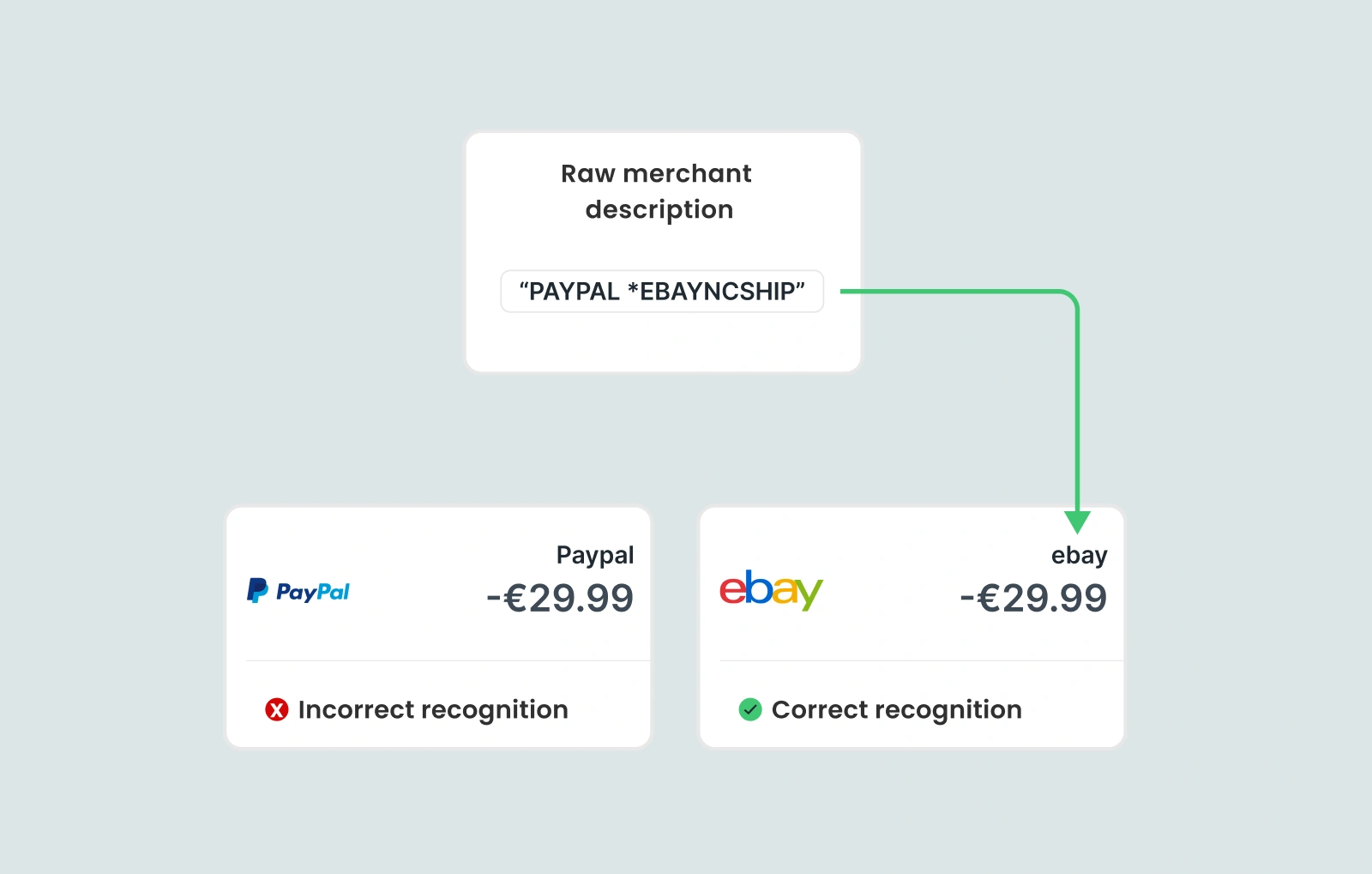
That split has direct consequences for the data the issuing bank sees. The sub-merchant's name, location, and category may or may not be passed cleanly through to the transaction message, and the same business can move between PayFacs without the issuer being able to detect that anything has changed. A retailer using Stripe today and Adyen next year will generate completely unrelated sub-MIDs for what is the same business.
What a MID looks like in transaction data
In the transaction message that arrives at the issuing bank, the MID appears as a field (typically called merchantId) sitting alongside the merchant descriptor, the MCC, the terminal ID (posId), and the location fields. It is usually a numeric string, but the exact format varies by acquirer.
What the MID does not do is tell the issuer who the merchant is. It identifies which acquirer account generated the transaction, nothing more. There is no global MID registry. Issuers cannot look up a MID and get back a verified merchant name, address, or category. The MID is meaningful inside the acquirer's environment; outside it, it is just a string.
Why one merchant has many MIDs
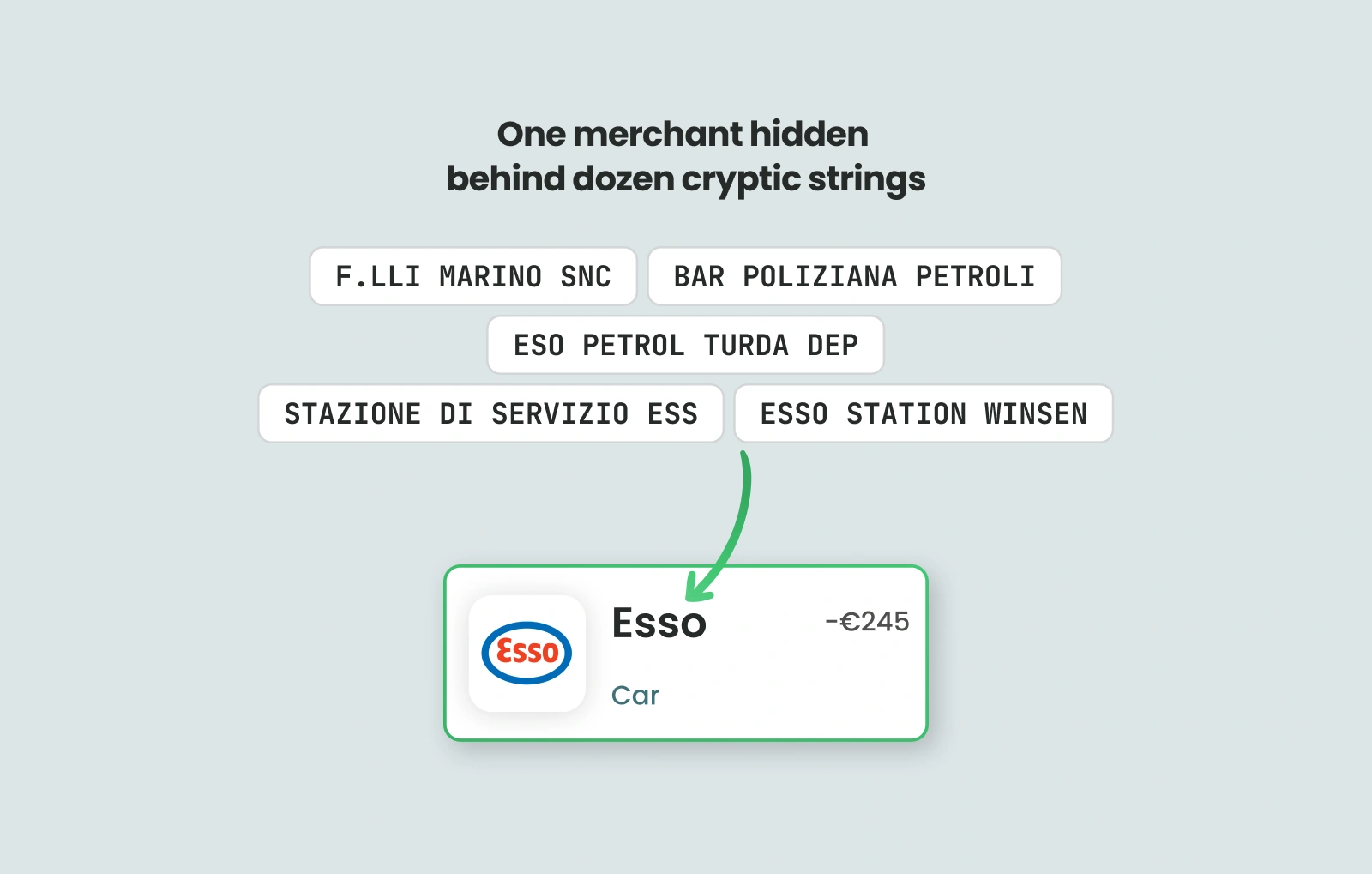
This is where the data quality problem becomes specific. A single real-world merchant routinely generates multiple MIDs, and from the issuing bank's perspective those MIDs look like different merchants unless something resolves them.
The main drivers:
Multiple acquirers. Large retailers rarely route all card volume through a single acquiring relationship. They spread risk, negotiate better rates, and maintain redundancy by working with two or three acquirers in parallel. Each acquirer issues its own MID.
Multiple countries. Acquiring relationships are usually market-specific. A retailer operating in Germany, France, the Netherlands, Belgium, and Spain will typically have a different acquirer - and therefore different MIDs.
Multiple channels. In-store, online, and in-app payments often run through separate merchant accounts even when they belong to the same business. The card-present channel might use one acquirer; the e-commerce channel might use a different one entirely.
Multiple legal entities. Franchise networks, holding structures, and group companies each operate as their own legal entity. Each entity is onboarded separately and gets its own MID, even when the customer-facing brand is identical.
PayFac sub-merchant structures. Under a payment facilitator, each sub-merchant gets a sub-MID under the master account. A merchant who moves between PayFacs, or who uses multiple PayFacs for different products, ends up with multiple sub-MIDs that may not be obviously linked.
Take a supermarket chain operating across five European markets. Local acquirer relationships in each country, separate MIDs for in-store and e-commerce, franchise outlets onboarded under different group entities, and a couple of regional PayFacs handling specific store formats - and that single brand can realistically generate 20 to 30 distinct MIDs. None of them tagged in a way a bank can actually use.
Why this matters for banks and fintechs
Every downstream use of transaction data depends on knowing which merchant a transaction came from. When the same merchant appears under multiple MIDs without a resolution layer, the most important issuer-side features break in subtle ways.
Transaction categorisation drifts. The same retailer ends up in two or three different categories. Spending analytics get cut into pieces. A customer's total spend at a given retailer is invisible to the bank if those transactions are split across ten MIDs that the system treats as ten separate merchants.
Fraud detection loses signal. Unusual MID behaviour is a meaningful fraud signal - sudden volume from a previously dormant merchant account, geographic anomalies, abrupt descriptor changes - but only if the bank knows which MIDs belong to the same underlying merchant.
Credit decisioning gets noisier. Merchant-level spend patterns are increasingly used in affordability checks, income verification, and lending decisions - the kind of behavioural detail that creditworthiness models built on transaction data depend on. Those patterns are only useful if merchant identity is resolved across the multiple MIDs a real merchant generates.
PFM and customer experience suffer the most visibly. Customers see fragmented or unrecognisable transaction entries when MID-to-merchant resolution is missing - the same retailer appearing under three different names in the same statement, online purchases showing up under a PayFac descriptor instead of the merchant they actually bought from.
How Tapix uses the merchant ID
The merchantId is one of the core input parameters in the Tapix card transaction enrichment API. When a bank or fintech calls the /shops/findByCardTransaction endpoint, the ideal request includes posId, merchantId, description, city, and country - exactly the fields that arrive in a raw card transaction message from the network.
The merchantId is not required in isolation. Tapix is built to work with whatever combination of fields the bank can provide, and partial requests still resolve when the available signals are strong enough. But the presence of merchantId materially improves match quality. Sending only merchantId without supporting fields can return an unsolved result, because a MID on its own is just a string scoped to one acquirer. Combining it with posId, description, and location significantly increases the likelihood of a clean match.
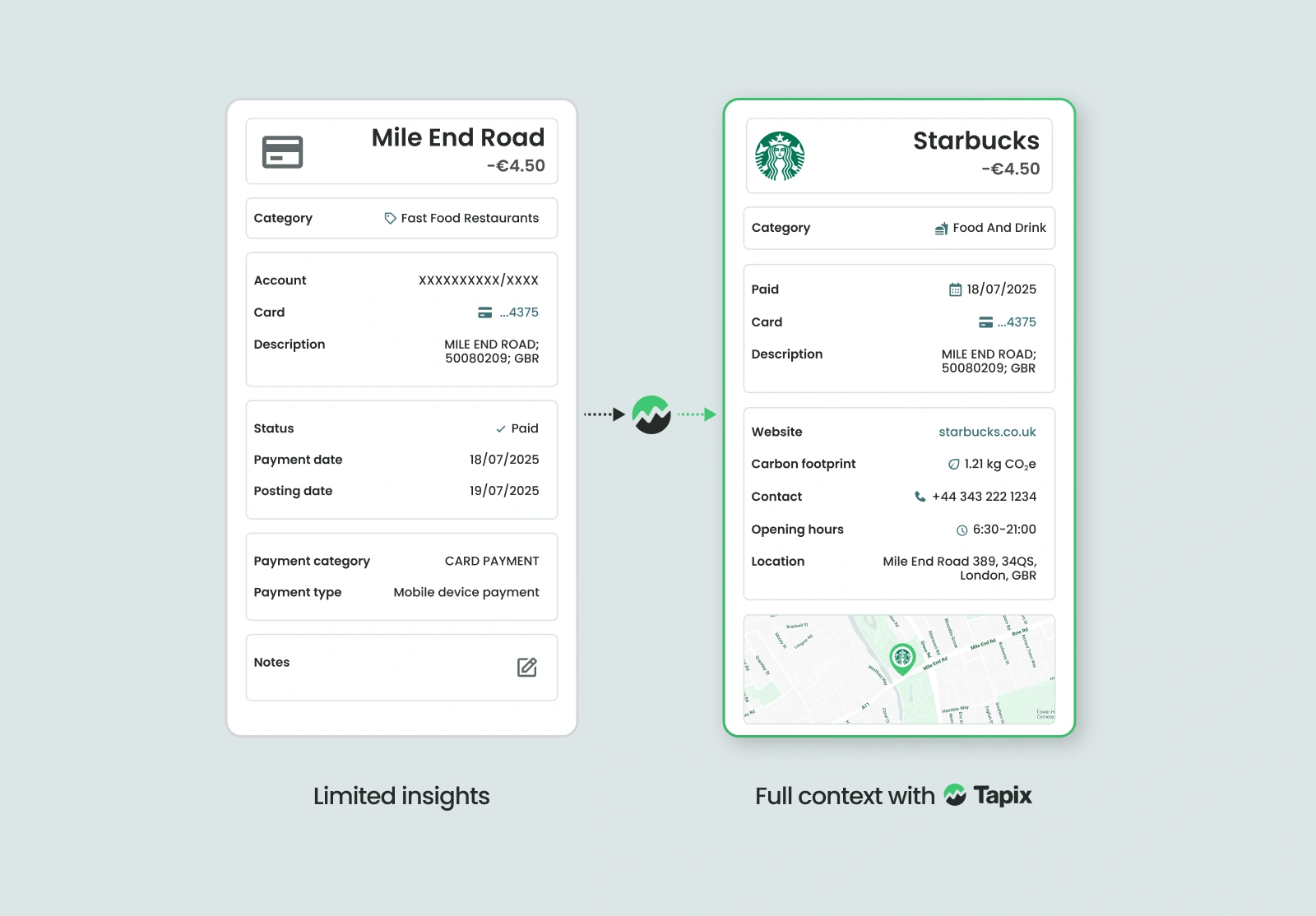
This maps directly to the fragmentation problem. A bank sending transactions from a merchant operating across multiple acquirers will see different merchantId values for the same real-world business. Tapix resolves this at the data layer - the API returns a consistent shop.uid and merchant.uid regardless of which merchantId or posId triggered the lookup, so the supermarket chain with 30 MIDs across five markets becomes a single merchant entity in the bank's enriched feed.
The output is the structured set of data points the bank actually needs to display and act on: clean merchant name, logo, four-level category, GPS coordinates, Google Places ID, and website URL - all linked to a stable internal identifier that persists across terminal changes, acquirer switches, and shop relocations. Banks integrate against that stable identifier, not the raw MID, which means downstream features keep working even when a merchant moves between acquirers or restructures their legal entities.
