How banks turn recurring payments into a product customers rely on
The Visa mandate is a compliance floor. The product sits above it.
Since April 2026, every European card issuer must let cardholders view, block and pause subscriptions in-app. Banks that treat that as a minimum ship a list. Banks that treat it as a product ship a feature customers open every week.
This 22-page playbook covers who is already live, the UX patterns they deployed, and the data layer that decides whether the feature works or frustrates users.
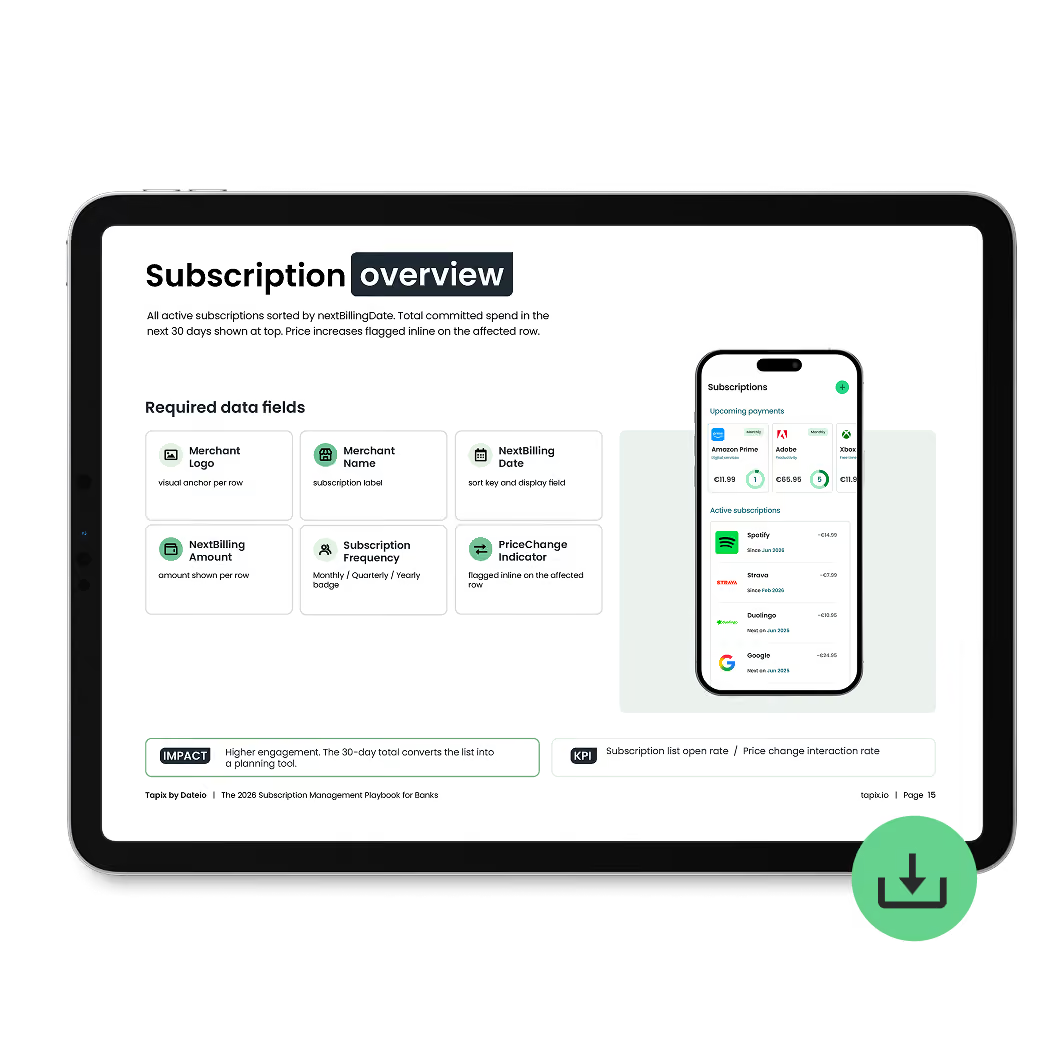
What does this whitepaper include?

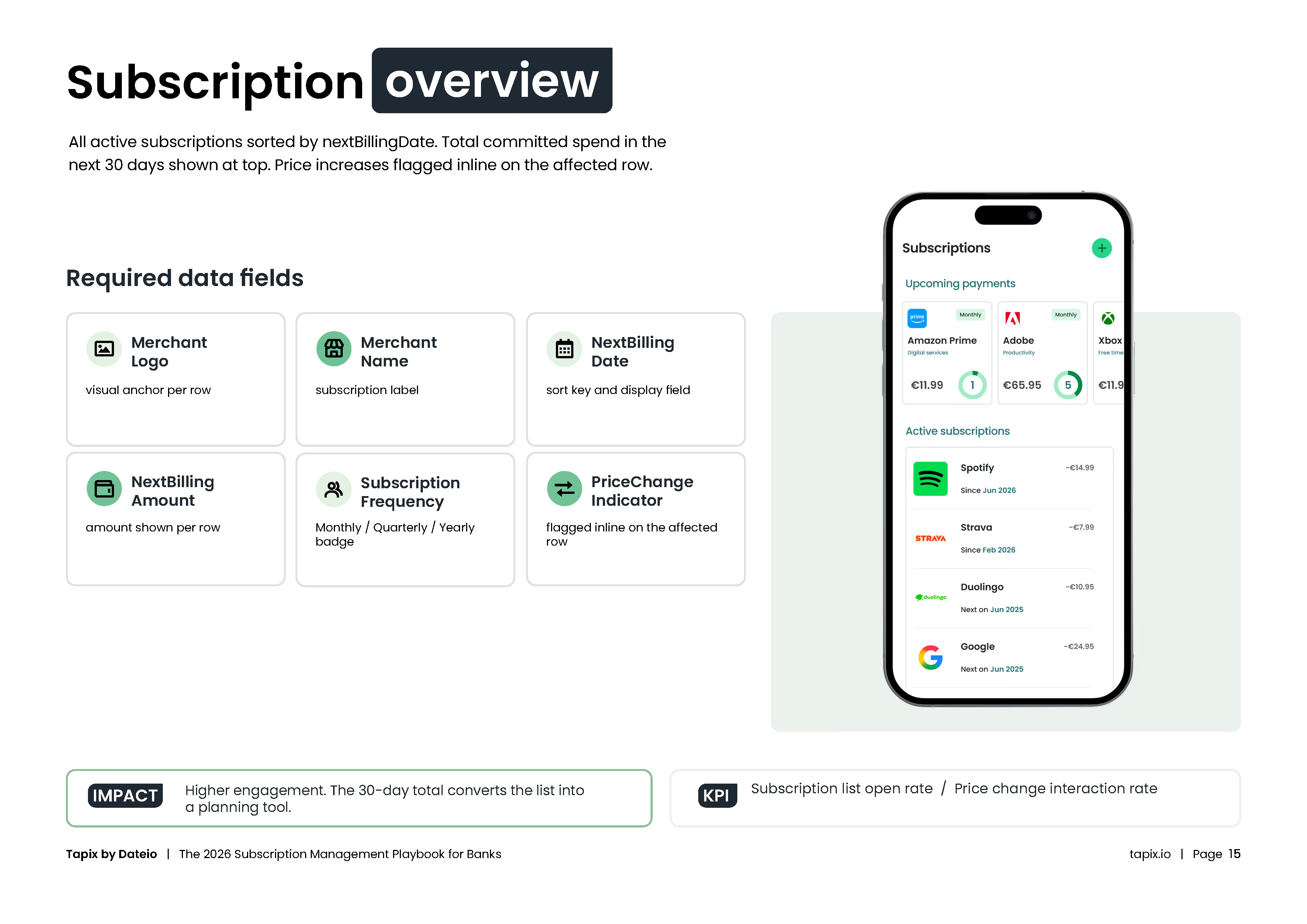
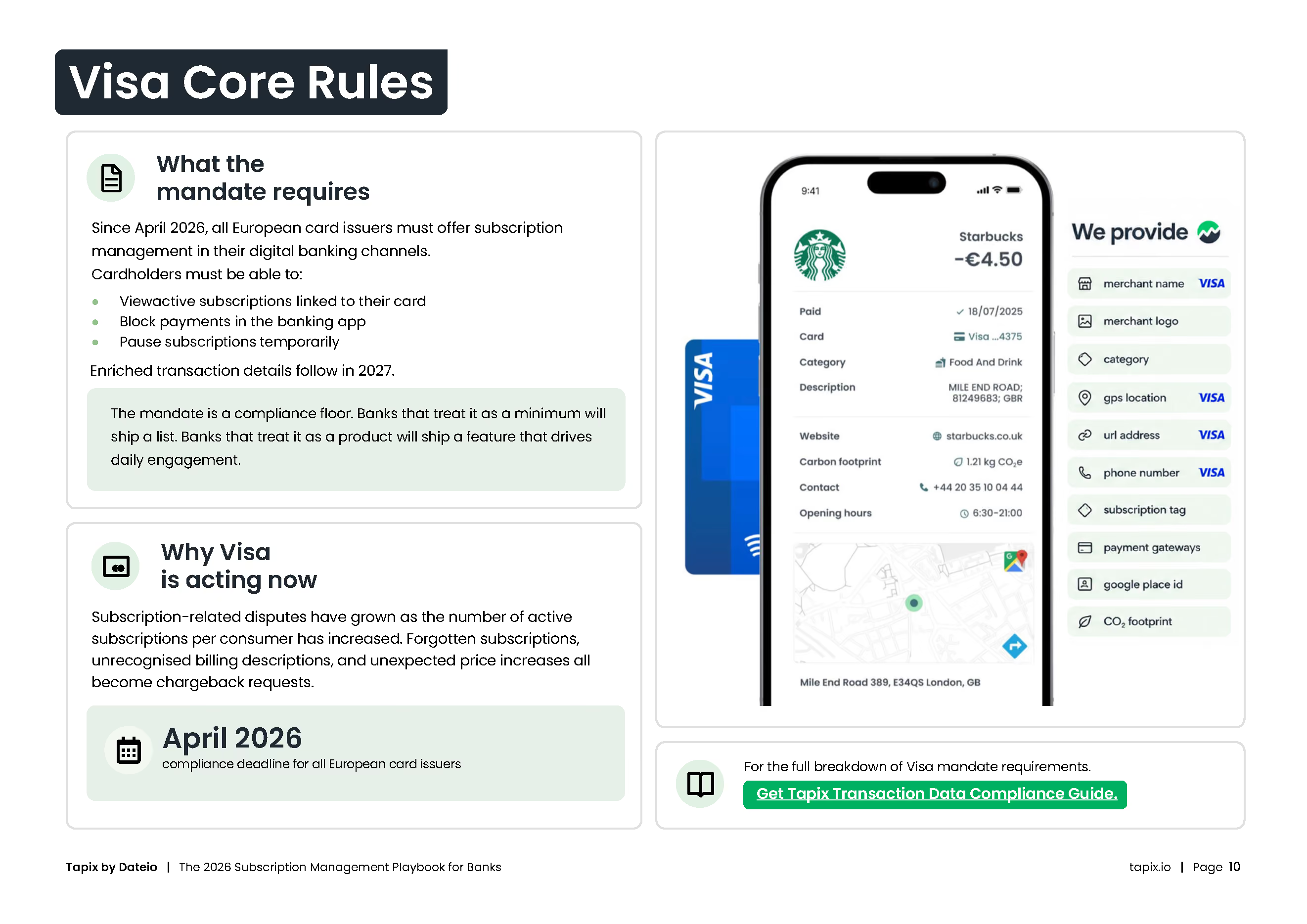
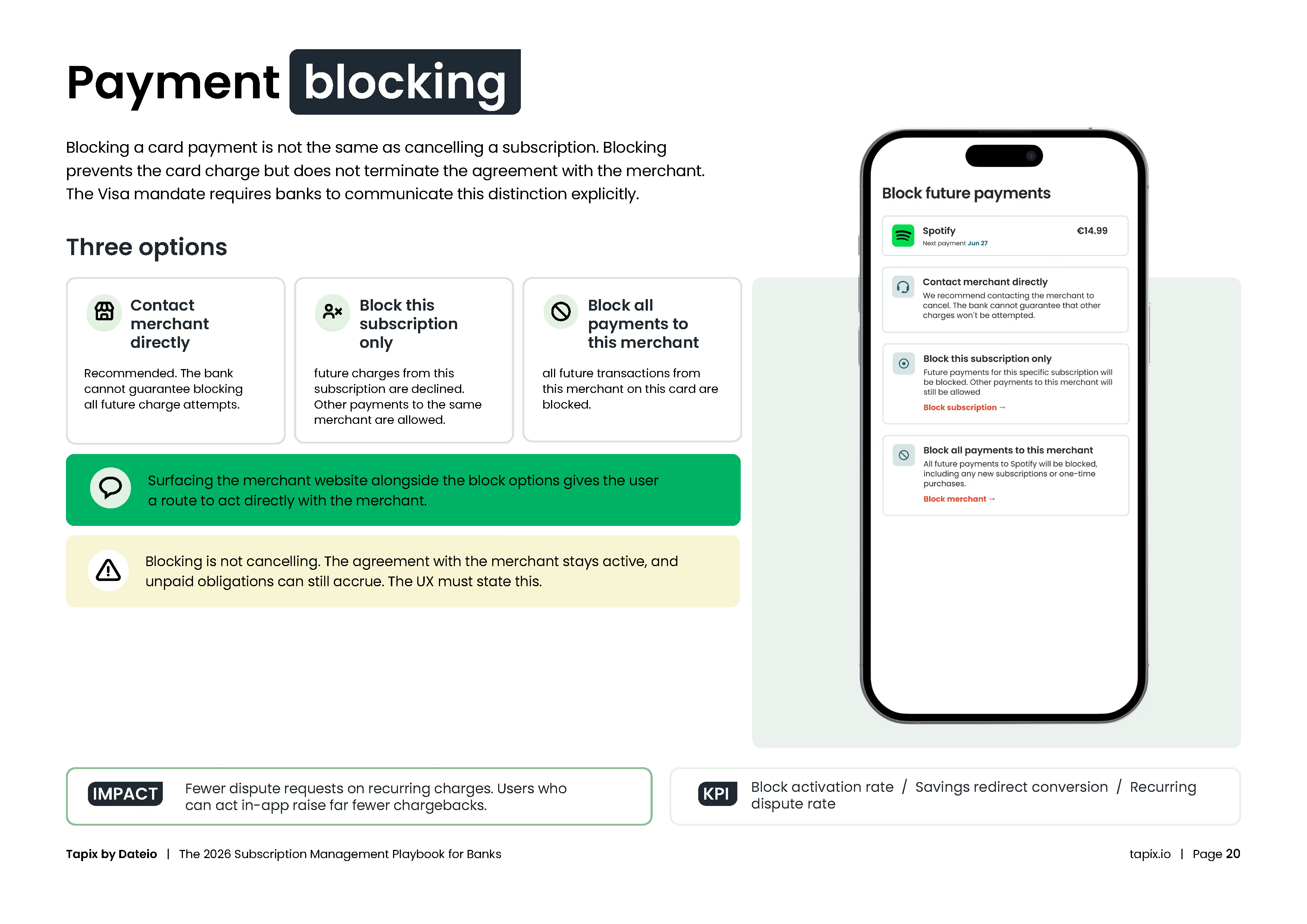
Clean transaction data moves four different scorecards
Written for product owners, UX and design leads, customer experience and risk owners, and data and analytics teams. Every solution in the guide names the data it needs, the KPIs it moves, and the team that owns it.

Requirements that arrive pre-mapped
Every solution lists the data points it depends on, so you can size it before you brief engineering.

Designs based on real data
See how leading apps present merchants, categories and recurring charges, and what they show when a data point is missing.

Tickets that never get raised
Clean merchant names, logos and GPS data cut confusion, false fraud reports and avoidable chargebacks.

Quality targets you can defend
Coverage, accuracy and richness benchmarked as three separate metrics, so you can set a realistic target per data point.
Primary account leakage starts with recurring payments you don't show
Half of banks globally already offer in-app subscription cancellation. See the UX patterns, the data fields behind each, and what the Visa mandate requires.
Recurring payment detection FAQ
Frequently asked questions about how Tapix detects subscriptions, direct debits and recurring payments from transaction data.
Yes. We identify recurring payments across all payment types - not just cards (Visa, Mastercard). That includes bank transfers (standing orders, direct debits) and pattern-based recurring charges with no auto-renewal, like highway tolls and transport coupons.
No. Network data fields can carry errors, so we don't rely on any single parameter. Instead, we combine multiple data approaches with human review and internal expertise to maximise accuracy.
Yes. Card-on-file and recurring payments are two different ways of looking at a customer's payment commitments. You can read more abput concepts regarding subscription managment in our article here.
For each recurring payment we return: frequency, next billing date, next-amount type (same, approximate or unknown), and an automatic-charging flag. It’s the perfect data set for building advanced subscription dashboards.
It turns a passive statement into a planning tool. Showing what's coming lets you warn on low balance before a renewal fails, cut surprise "friendly-fraud" disputes, and position the bank as the customer's planning partner.
Yes. Once we identify a transaction as recurring, we add the predicted next billing date and amount indication directly to it - so you can surface upcoming charges to customers before they happen.
We separate them by pattern, not by merchant. Take YouTube: one transaction might be a one-off movie rental, another a recurring YouTube Premium subscription. We assess each transaction on its own behaviour, so mixed-billing merchants are handled correctly.
From our own database. We don't depend on direct connections with merchants or on any single data-message field - the intelligence is built and maintained entirely on our side.
Both. Covering the top global brands (e.g., Netflix, Spotify) is the easy part; our focus is granular, market-by-market coverage. On a single market we typically see hundreds to thousands of merchants offering different billing plans, and we work to capture them all.
Little to none for known merchants. Because coverage is cumulative and shared across clients, once a merchant is established in our database we recognise it for you - often from an early charge, without waiting for your own repeat pattern. Only a merchant that's brand-new to us needs a second sighting.
Continuously. We run regular updates and data-quality controls on a daily basis, so new merchants and refreshed information flow through to all clients automatically.
No - that typically sits with your payment processor. We can share best practices from integrations we've already supported. Keep in mind that blocking a payment isn't the same as canceling a subscription. To actually cancel, customers need to go to the merchant's site. You can make this easy by redirecting them using the merchant URLs Tapix provides.
The Visa mandate has two parts: listing and blocking subscriptions. We fully cover the listing side and help you build blocking together with your payment processor. But the mandate is only the floor - there's far more opportunity to build a great product on top of the minimum Visa requirements.