A mid-sized European retail bank with 5 million active card customers sees around 1,5 billion card transactions a year - every purchase a data point on where the customer shops, what they spend on, and how their habits shift over time. The raw material for almost every personalised banking product sits in that feed. The question is not necessarily about access, more like whether the data, once you reach for it, is usable enough to build on - clear enough for customers, structured enough for analytics, consistent enough for credit and risk models.
This article looks at the three variables that decide whether transaction data enrichment delivers real business value or just cosmetic improvement - coverage, accuracy, and information richness - and the concrete impact each one has on the products built on top.
The data problem every banking product inherits
Every banking product that matters, be it PFM, fraud detection, credit scoring, sustainability tracking, push notifications, or card-linked offers, is built on top of transaction data. When that data is raw and inconsistent, every product built on top of it inherits the chaos. The features look modern in the design files and break the moment they meet real spending behaviour.
Transaction data enrichment fixes the foundation. It resolves merchant identity from raw acquirer strings, adds structured categorisation, and returns a consistent set of data points for every transaction - the merchant name, logo, category, location, and the metadata downstream products depend on.
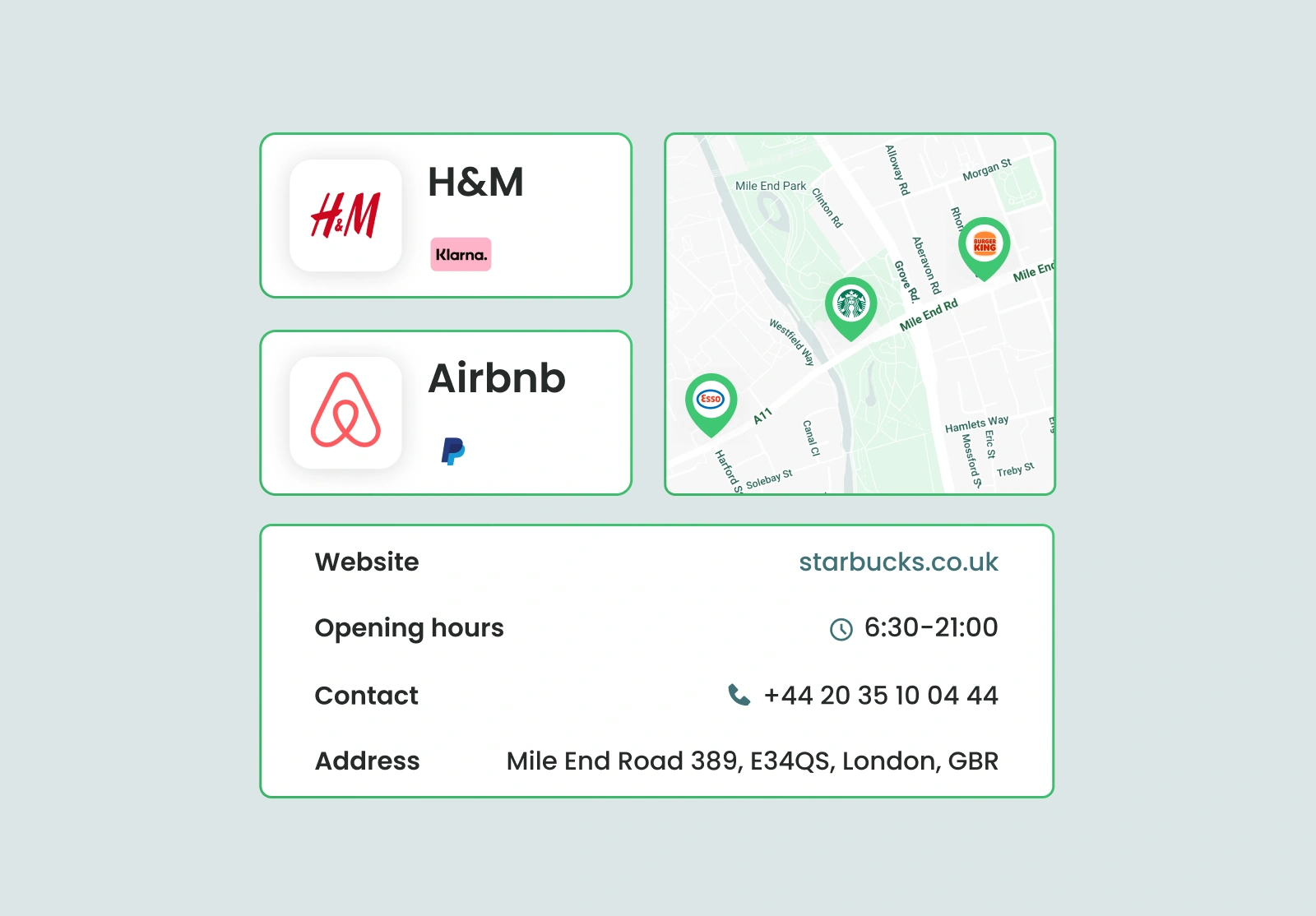
Three variables decide whether enrichment delivers real business value: coverage (what share of transactions get enriched), accuracy (whether the enrichment is correct), and information richness (how much structured data is returned per transaction). The relationship between them is not additive. Push coverage up by enriching transactions the model is unsure about, and accuracy drops. Tighten accuracy by only returning confident results, and coverage drops. The skill is hitting all three at the same level on the same data, which is what separates a useful enrichment layer from one that quietly creates more problems than it solves. A wrong merchant name and a wrong category are not neutral outputs - they are the noise the bank now needs to defend.
For scale context: Tapix enriches over 1.5 billion transactions per month across EMEA, LATAM, and NCA, with coverage in the 65–85% range and 99.99% accuracy - fewer than one complaint per six million transactions.

Why accuracy is the variable that gets underestimated
Most vendors lead with a single coverage number. That is the wrong metric to evaluate first, because coverage without accuracy is just confident wrongness at scale.
The fastest way to see what inaccurate enrichment actually costs a bank is to follow what happens when the customer doesn't recognise a transaction. They stare at the entry in the app, they don't remember the merchant, the category looks wrong, and the bank now has a choice: take the support call, take the dispute, or quietly take the trust hit. None of those are free. And the underlying signal - that the bank does not appear to know what is happening with the customer's money - is far more damaging than any individual dispute.
The MCC-only benchmark is the clearest illustration of why enrichment matters here. MCC codes alone cannot reliably categorise a meaningful share of card transactions - internal Tapix analysis suggests only around half of card transactions can be confidently categorised on MCC data alone. The rest end up in the wrong category, or in no category at all, without enrichment on top.
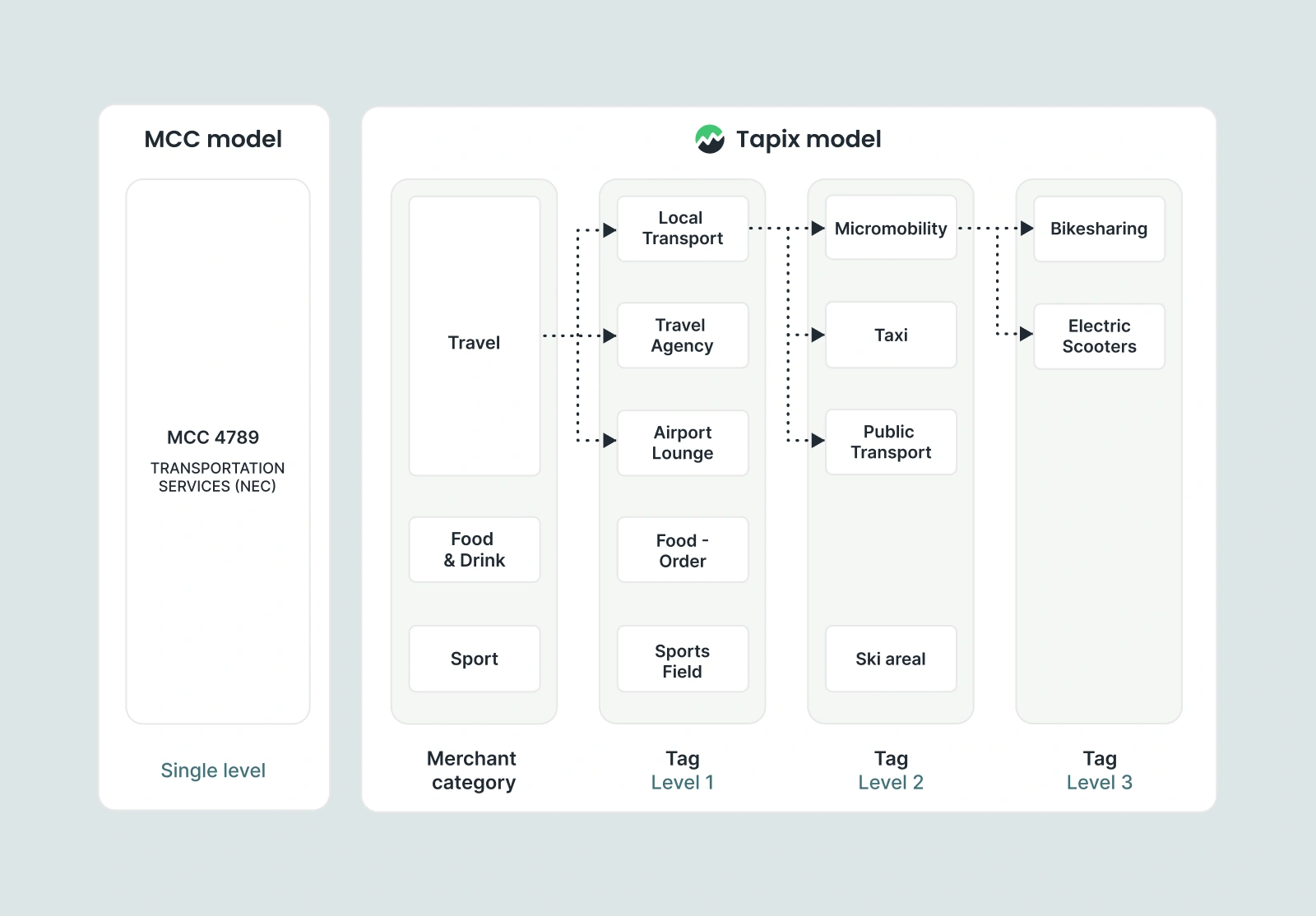
Sustainability products show the same pattern, even if carbon tracking sits outside most banks' top-five priority list. A €50 transaction sitting under a general "transport" MCC might return around 49.8 kg CO₂e. The same €50, enriched to the actual merchant, could be a ski-lift ticket at 5.6 kg CO₂e, a long-distance bus journey at 25.5 kg CO₂e, or a bike-sharing trip at 2.3 kg CO₂e.
The cost of data inaccuracy in digital banking compounds across every product surface that touches the transaction feed.
Where enrichment breaks: international spend
Travel is the failure point most often glossed over in vendor demos.
When a customer pays abroad, the transaction data arriving at their home bank is often at its worst. Foreign acquirer formats, unfamiliar descriptor conventions, local merchant names in non-Latin scripts, and MCC codes assigned by acquirers operating under different classification standards all collide in the same feed. Enrichment models trained primarily on domestic data have no consistent way to resolve them.
For banks relying on domestic-first or regionally limited enrichment, international transactions routinely fall into the "Other" category or return raw terminal strings - exactly when the customer is most likely to be anxious about an unfamiliar charge and most likely to call support. Unrecognised foreign transactions are one of the top triggers for unnecessary fraud disputes, which cost the bank in both operational overhead and customer trust.
Tapix covers 112+ markets with consistent merchant resolution across geographies. The same data quality a customer sees on a domestic transaction applies when they pay in Warsaw, Lisbon, or Bangkok.
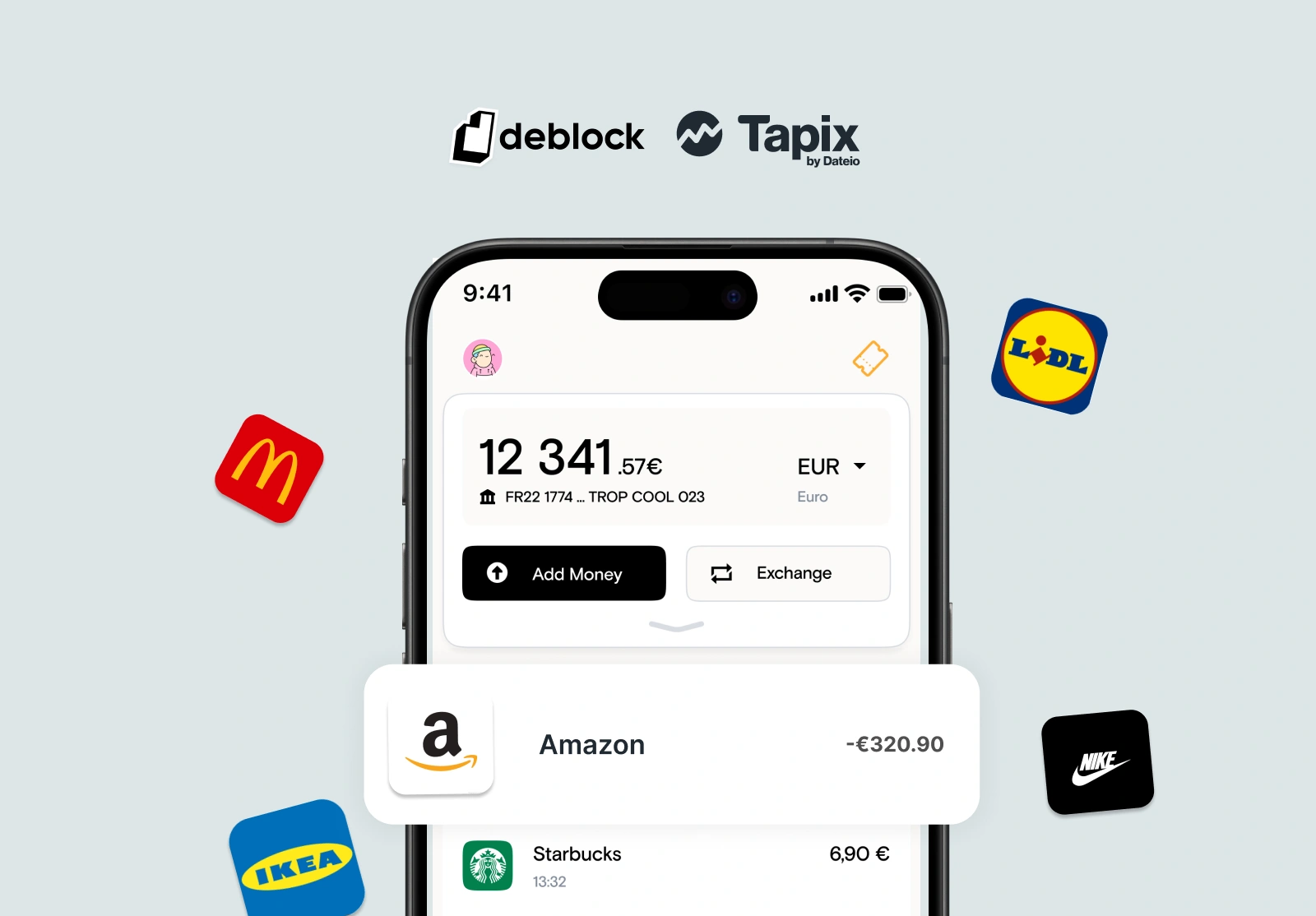
Deblock illustrates what this looks like in practice. The fintechs user base makes cross-border payments by design, combining a fiat current account with a crypto wallet, so international transactions are the norm here. Their internal enrichment solution covered less than 50% of transactions. After integrating Tapix, merchant coverage rose to 75% within one month, and millions of historical transactions were backfilled for consistency.
What information richness unlocks: five use cases
Coverage and accuracy get the data in the door. Information richness determines what you can actually build on top of it. The five use cases below are the ones banks consistently invest in once their data is enriched.
For the full case studies, see 5 ways leading banks use transaction data enrichment.
1. Clear payment history and dispute reduction
The baseline use case, and the one with the most direct impact on operational cost. Clean merchant names, logos, and recognisable transaction entries reduce the volume of "what is this charge?" support contacts and pre-empt a meaningful share of friendly-fraud disputes.
Poorly labelled transactions are among the top drivers of customer support calls in retail banking. Each call is staff time the bank pays for, and each dispute is operational overhead it would not otherwise need to absorb. Enrichment cuts both at the source.
Swisscard is a good example. The Swiss card issuer needed to comply with Mastercard AN4569 - verified merchant names, logos, addresses, and contact details for every transaction. Without consistent enrichment, the same merchant appeared in multiple formats across the feed, creating confusion for customers and unnecessary load for support teams.
2. App UX, engagement, and retention
The transaction feed is the most-used screen in any banking app. When it's unreadable, the whole product feels unreliable. Customers move their primary account, they stop spending through the card and leave one-star reviews on the app store citing "I can't see what I'm paying for." Enrichment fixes the surface that customers actually see.
PFM is the most-cited example because it depends entirely on category reliability. If "Other" is the largest spending category in your app, your PFM is broken - and so is every analytics output that feeds off it. Four-level categorisation that goes beyond MCC is what makes PFM work: distinguishing an organic food shop, a convenience store, and a hypermarket that all share the same MCC code, consistently across the customer base.
Beyond that, rearchable, recognisable transactions improve every secondary feature - subscription management, spending alerts, in-app receipts, family-account views.
3. Credit scoring and CCD2 compliance
Enriched transaction data gives lenders a verified, structured view of income patterns, recurring obligations, and discretionary spend - a far more reliable foundation for affordability assessment than raw transaction data, which require manual interpretation that does not scale.
Under CCD2, with full application across Europe from 20 November 2026, lenders must demonstrate affordability based on accurate, verified financial information. That puts enriched transaction categorisation at the centre of every credit decision - particularly for BNPL providers and small-ticket consumer credit, which the directive brings firmly into scope for the first time.
MCC-only data produces a distorted picture of customer financial behaviour. Income shows up as ambiguous credit lines, recurring obligations get lost in generic categories, and risky behaviour patterns like gambling or payday credit cycling are easy to miss. Enrichment corrects that distortion at the source, before the credit model ever sees the data.
4. Sustainability and carbon footprint tracking
Carbon footprint products built on MCC codes return figures too generic to be credible or actionable. They tell a customer they spent on "food retail" and assign an industry-average emissions value - useful as a label, useless as a behavioural signal.
Raiffeisenbank Czech Republic uses Tapix Eco Track to map transactions to specific merchant types rather than broad industry codes, with emissions factors that vary by country. A grocery transaction now reflects whether the spend went to an organic store, a discount chain, or a convenience store, and adjusts accordingly.
"When it comes to sustainability, we knew that relying solely on MCC wasn't providing meaningful results." - Michal Putna, Sustainability Officer, Raiffeisenbank Czech Republic
5. Hyper-personalised communication and card-linked offers
Enriched spend data lets banks identify the right moment for a relevant offer - not just the right segment, but the right merchant context at the right time. A skiing-related transaction can trigger a prompt that the customer’s travel insurance does not cover winter sports, with an in-app option to upgrade immediately. That is a use case that simply does not exist on raw transaction data.
The maths on relevance is straightforward. Targeted campaigns built on accurate data reach more relevant users – 14 % relevance versus 12 % on inaccurate data. On a base of three million users, that is 60,000 additional relevant contacts per campaign and roughly 3,000 additional conversions at a €1 revenue-per-user rate. Small percentages, but large absolute numbers.
How Tapix delivers across all three dimensions
The case for enrichment is the same case for getting coverage, accuracy, and information richness right at the same time. The three numbers below are how Tapix delivers each.
Coverage - 65–85 % across 112+ markets, with the engine learning fast in new regions as fresh transaction patterns enter the system. International spend gets the same treatment as domestic, which is the point.
Accuracy - 99.99%, with fewer than one complaint per six million transactions. Tapix does not return a result unless confidence is high enough; an unsolved transaction is preferable to a confident wrong answer, because confident wrong answers are what trigger disputes, support calls, and the slow erosion of trust in the app.
Information richness - Tapix returns merchant name, logo, four-level category, GPS coordinates, Google Places ID, website URL, phone number, payment gateway identification, recurring payment flags, and CO2 data in a single call. The relevant comparison is not "do you return a category?" but how deep that category goes, how many other linked data points come with it, and whether all of them are consistent across markets. That depth is what determines what a bank can build.
For teams ready to evaluate, the best practices for transaction enrichment API integration cover the practical questions - sandbox access, fallback design, and the metrics worth tracking once enrichment is live. The Tapix developer portal provides direct sandbox access.
