An established bank earns several times more per customer than a neobank, and almost none of that comes from the app. It comes from the balance sheet: the salary that lands each month, the direct debits that clear against it, the mortgage sitting on the other side of the ledger. The app is where the relationship is defended or lost, but the money is made somewhere else.
This digital banking engagement playbook is about which app features actually move the number that pays back.
Who earns more per customer
Set the two models side by side on the same basis. Measured as annual revenue per customer, Barclays' UK consumer and business arm generates roughly £435, around six times what Revolut earns per customer. This pattern holds beyond just one incumbent: across European retail banks, annual revenue per user runs several multiples above the neobank average, an ARPU gap the sector has not closed.
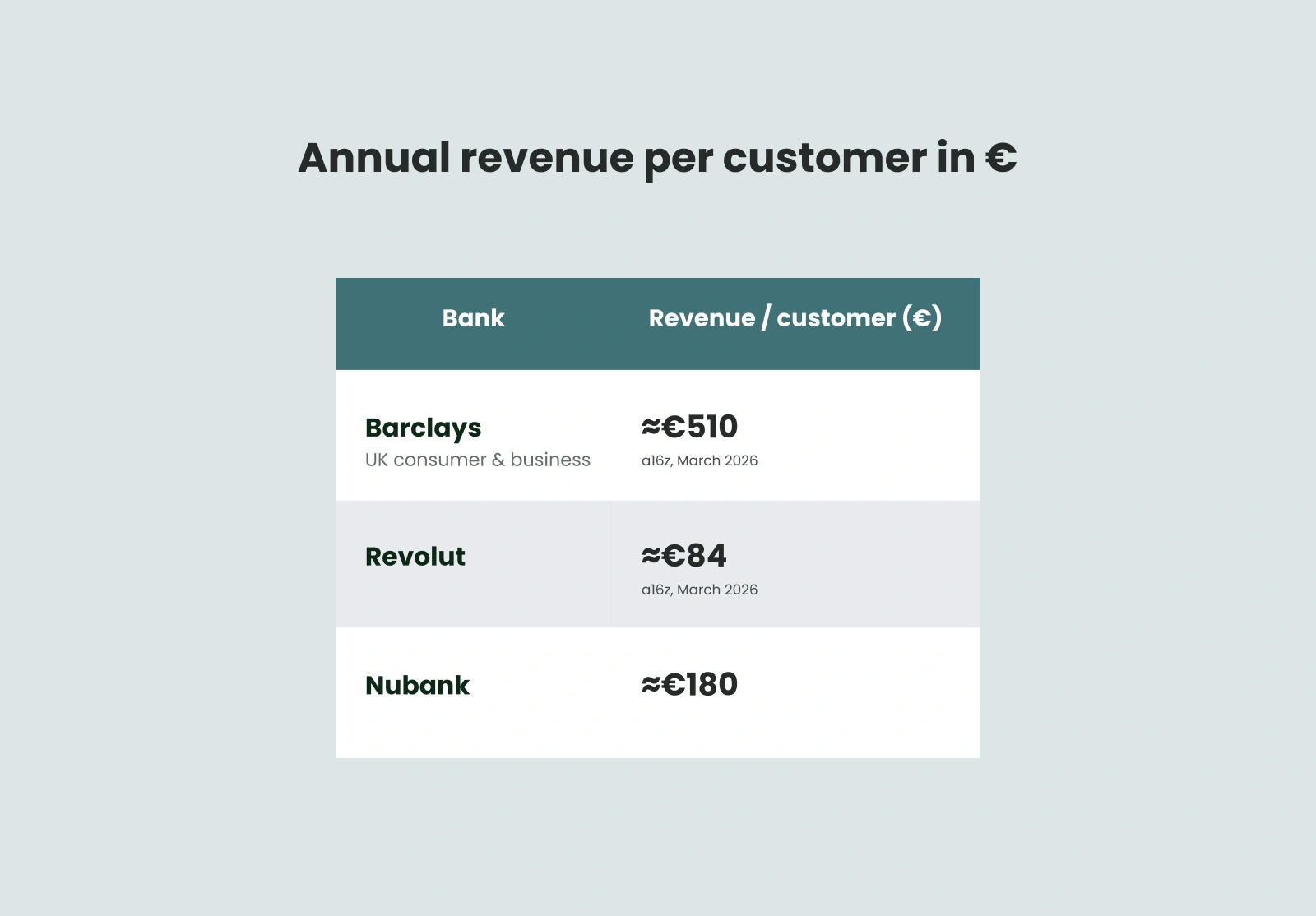
Nubank, the most efficient scaled neobank in the world, reached monthly average revenue per active customer of $17.1 in Q2 2026, up from $12.5 a year earlier, against a cost to serve of roughly $1. Strong for a neobank, still a fraction of what an incumbent earns from a primary customer.
The reason is the composition of the relationship. An incumbent's per-customer revenue comes from the salary paid in, the direct debits set up against it, and the loan on the same balance sheet, not from how often the app is opened. BBVA makes this visible: in Spain, customers who use its financial-health features show NPS around nine to ten points higher than those who do not, and a meaningful share of the bank's investment-fund and mortgage sales come through those tools. The features did not just improve satisfaction, they correlated with the products that carry the margin
Where the neobank still does not reach
Neobanks do not begin by competing for the whole relationship. They start with a single simple use case, typically foreign exchange, cross-border transfers, or remittances, then bundle outward from there: a card, then savings, then investments, then credit, deepening the relationship one product at a time. The measure that matters is products per customer, and for the winners it climbs year over year.
Nubank is a good illustration of this principle: its oldest users sit in the mid-$20s of monthly revenue, several times a first-year customer, precisely because a customer who arrived for one product is using six or seven by year six. The path from simple use case to primary relationship is the whole game.
For a deeper look, read our take on how to build a digital bank.
What the early stages of that path do not yet capture is the deposit base. A neobank account still tends to hold spending, not savings, which keeps its revenue per customer low until the deepening is well advanced. Revolut ended the year with 68.3 million retail customers against £50.2 billion in balances, around £735 each, and its loan-to-deposit ratio sits at roughly 6%, against 70–90% for established banks. A bank that lends out 6% of its deposits is not yet in the lending business, and lending is where per-customer revenue comes from.
The gap is closing where banks are not watching
The threat is not acquisition. Neobanks are converting customers they already have into primary relationships, which is a product problem. Around 25% of Revolut's users under 35 treat Revolut as their primary account.
If this were about acquisition, the answer would be a marketing budget. It is existing customers deciding, feature by feature, that the challenger is where their financial routine will live. The answer to a product problem is product, and product built on clean, enriched transaction data, because the features that make an app worth living in all depend on the bank being able to read what a payment actually is.
The part of the balance that is already spoken for
The mechanism most engagement strategies miss is deposit leakage: the bank keeps the salary and the standing commitments, but loses the daily spending to a second account, and the deposit total stays healthy while it happens.
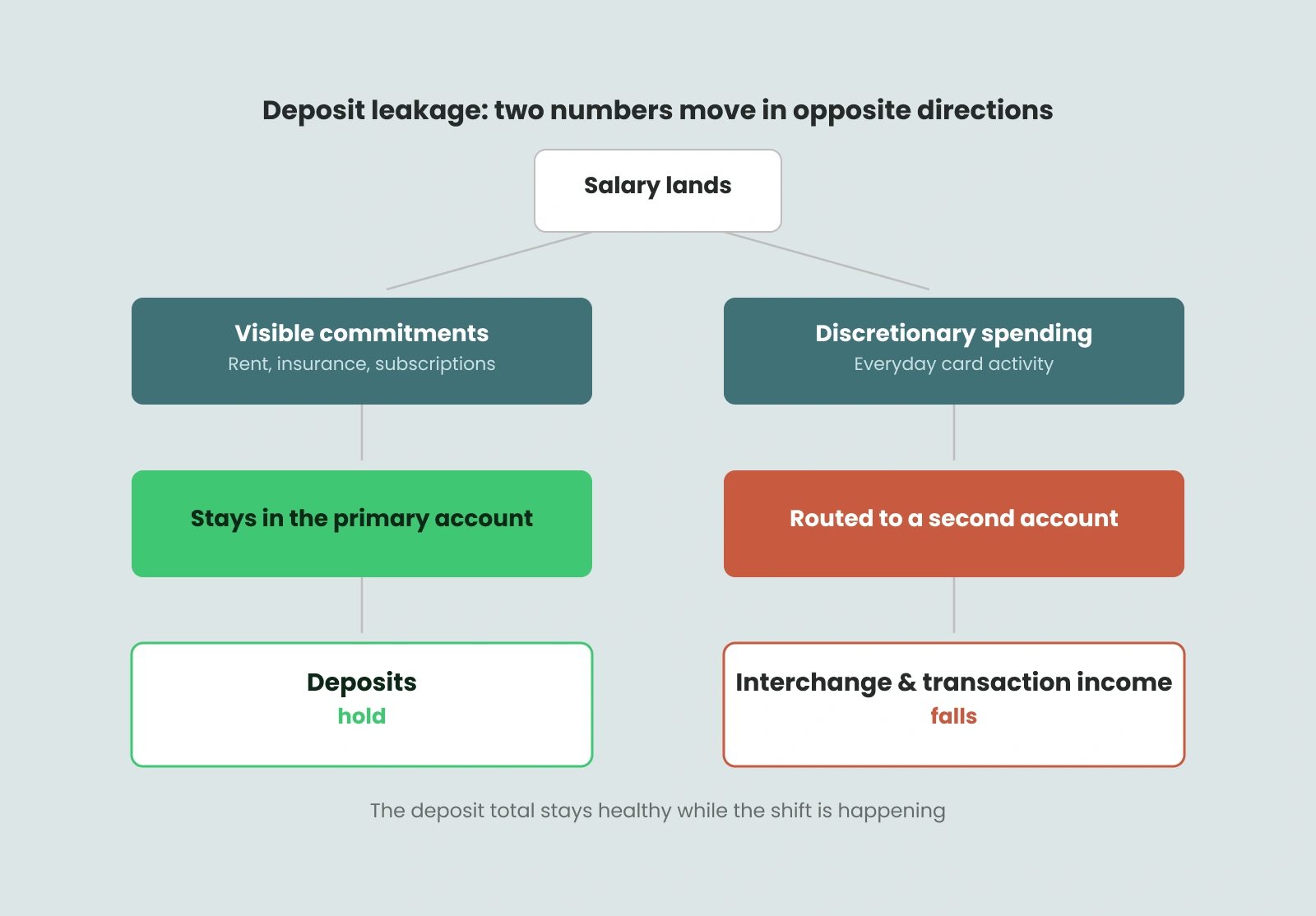
The cause is visibility. By the tenth of the month, much of a customer's balance is already claimed by rent, insurance, and card subscriptions they cannot see coming. The bank holds a complete record of those payments, but the customer holds none of it. So they route discretionary spending to a neobank where the money left after commitments feels clearer, and what leaves is exactly the card activity that generates interchange. The proof that this is leakage and not churn is in the two numbers moving in opposite directions: deposits hold because the salary still lands, while interchange and transaction income fall because that income tracks spending instead of a balance sitting still. The loss does not show in a deposit report until primary status has already moved.
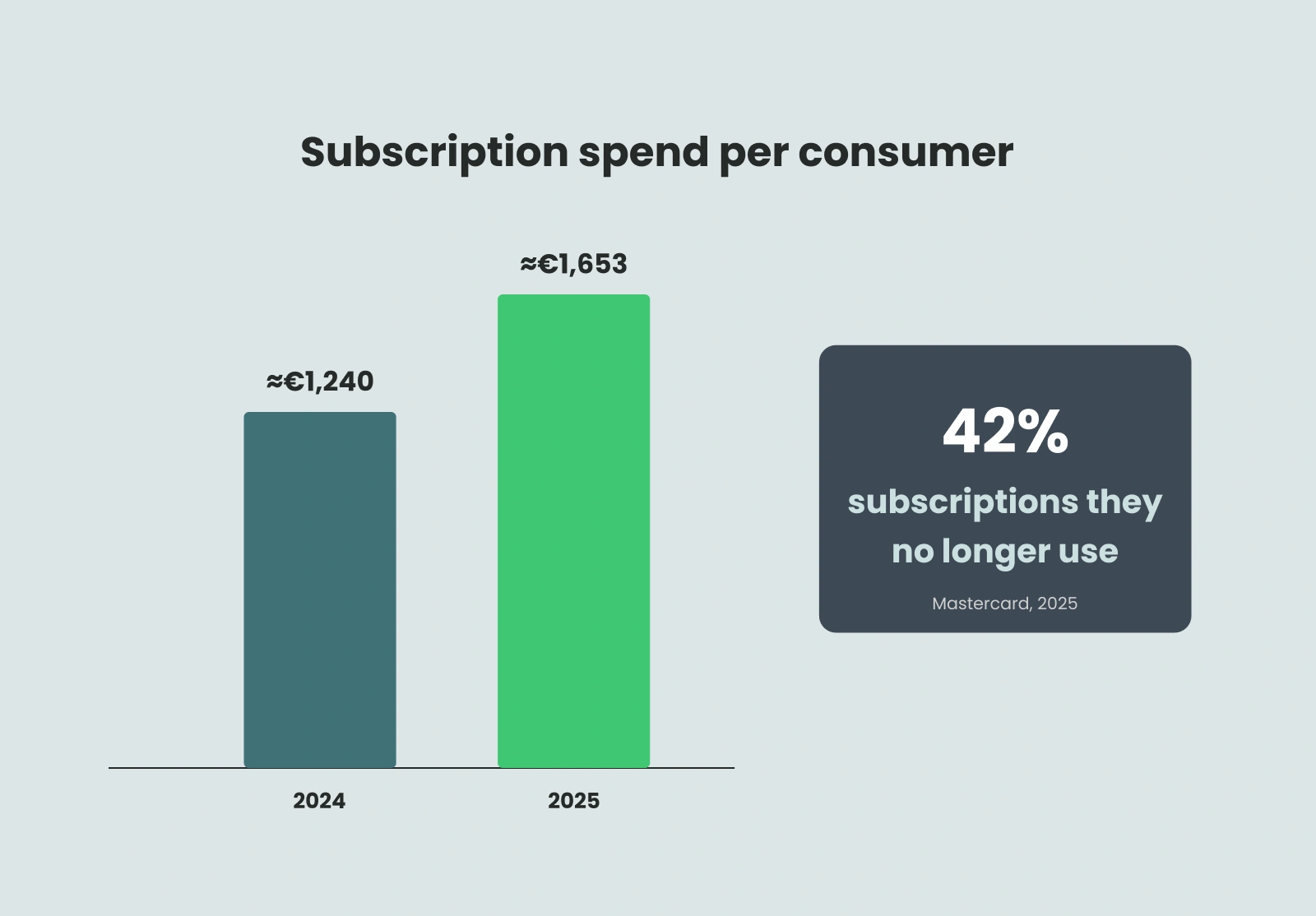
The committed share is larger than it looks. According to Mastercard, US subscription spend alone reached an average of $1,887 in 2025, up from $1,416 in 2024, and 42% of consumers admit paying for subscriptions they no longer use. Subscriptions are only the visible edge; the large recurring outflows are rent, insurance, and loan repayments, which rarely surface in a "manage your subscriptions" screen at all.
Making the commitments visible
Subscription management is the feature that answers the previous section, but the value sits in detection accuracy. Regulation is about to make the feature universal: Visa requires issuers in selected European markets to support subscription management from 18 April 2026. That settles that the feature exists. It does nothing to guarantee it shows the right amount on the right date, which is the only version of it that changes customer behaviour.
A useful view answers, across a month, what repeats, how much, when it bills next, whether it renews automatically, and what changed. That is harder than it looks, because recurrence arrives in at least four forms - card subscriptions, direct debits, standing orders, and unlabelled repeating transfers. Most solutions detect the first and miss the rest, which means missing rent, utilities, and informal standing payments.
This is where a data layer comes in. Tapix identifies and classifies recurring transactions across card subscriptions, direct debits, standing orders, and pattern-based transfers, delivering the merchant, frequency, next billing date, amount, and status as structured data a bank can build on.
Learn about the hidden cost of building in-house data enrichment solutions.
Acting before the payment lands
The banks that hold primary status move first on a payment they knew was coming, which is only possible when the amount and date are known in advance. BBVA covers a direct debit of up to €300 when the account is short, and alerts the customer to the bill beforehand. Both depend on knowing, ahead of time, that a specific charge is due on a specific day.
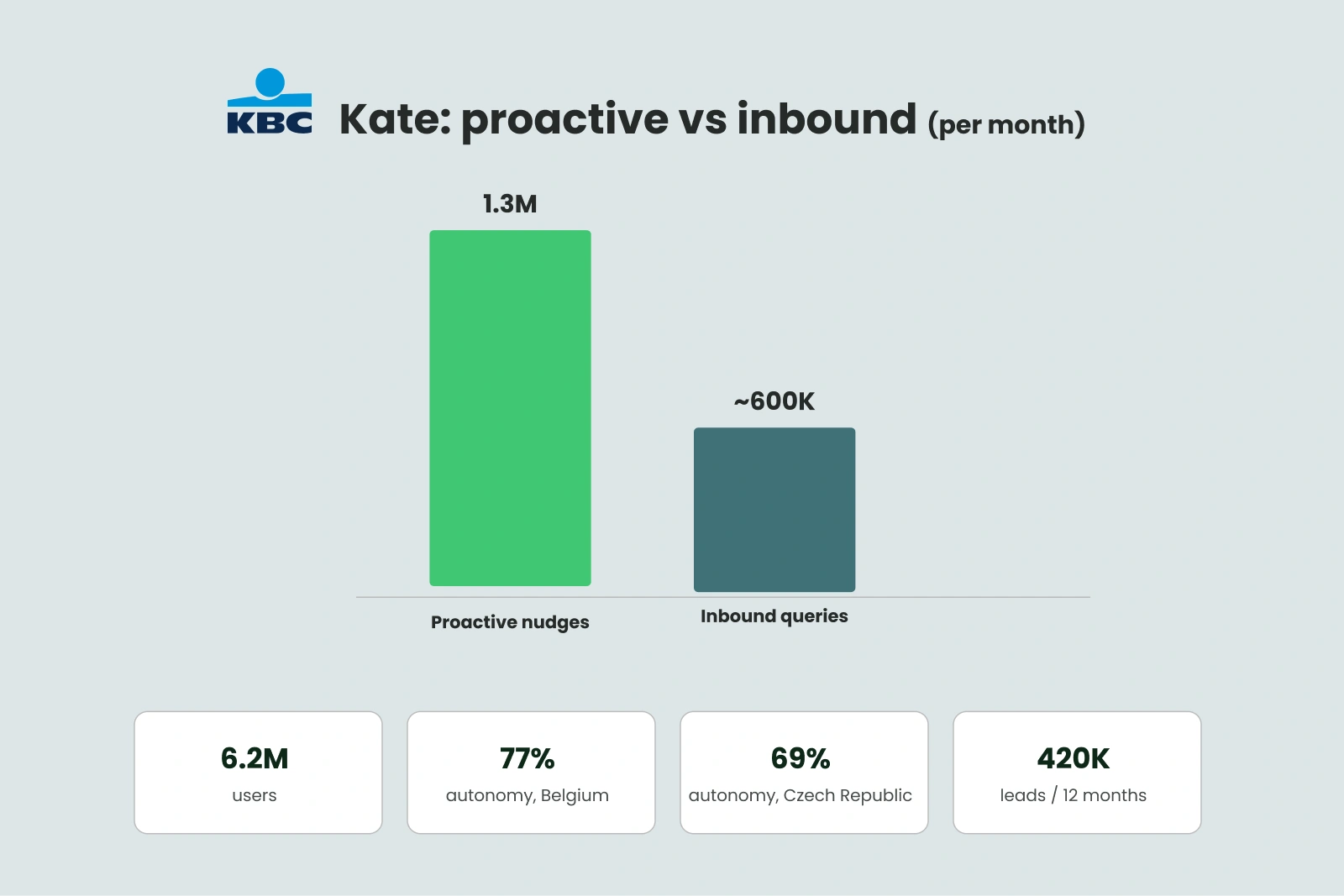
Restraint decides whether this reads as help or noise: a meaningful share of users cite too many notifications as their main reason for uninstalling an app. Speak only when you have something the customer could not have known, and you earn the next message the right to be read. KBC's assistant Kate shows disciplined proactivity at scale (6.2 million users, 77% autonomy in Belgium and 69% in the Czech Republic, 420,000 leads over twelve months) running around 1.3 million proactive nudges a month against roughly 600,000 inbound queries, across more than 125 unprompted situations.
More value comes from the bank speaking first than from answering questions, and speaking first requires knowing what is about to hit the account. Per-customer revenue lives in the commitments on the balance sheet, neobanks are converting existing customers into those commitments, and the defence is a bank that can see what its customers' balances are spoken for and act before the payment lands. Everything else in a digital banking engagement strategy is downstream of that.
