The difference between MCC and multi-level categorisation comes down to how many questions a bank can ask of a single card line. Take “TESCO EXPRESS 2291 LONDON GB”, merchant category code 5411: grocery stores and supermarkets. The app team needs a category the customer recognises at a glance. The CRM team wants to know whether this customer shops at convenience stores or hypermarkets. The risk team wants to know how much of the month’s spending is essential.
The MCC gives every team the same answer, set by the acquirer when the store first started accepting cards. Multi-level categorisation identifies the merchant and the exact store, reads the transaction at four levels of detail and maps the result into the bank’s own category structure. For business banking, it adds one more lens: each client’s own rules.
What MCC categorisation gives a bank
An MCC is a four-digit code that classifies a merchant by its primary line of business. The acquirer assigns it when the merchant starts accepting cards, and it travels with every authorisation. Card networks use it to set interchange, apply scheme rules and power card controls such as gambling blocks. For those jobs, one broad and stable label per merchant is exactly what the system needs.
As a spending category, the same label is less reliable. In the Tapix database, MCC alone placed 63% of transactions in the correct category. The remaining 37% landed in the wrong category or in none.
Want to know more? Read our Why MCC codes aren't enough overview.
How reliable a code is depends on the code itself. Some carry a clear signal: 7542 Car Washes, 8043 Opticians or 5995 Pet Shops almost always mean what they say. Catch-all codes such as 5999 Miscellaneous and Specialty Retail Stores or 7399 Business Services say almost nothing about what was bought. Reliability also shifts between markets, so a code that maps cleanly in one country can cover a different mix of businesses in the next.
None of this is a flaw in the network design. An MCC is one label, at one level of detail, seen from one point of view: the acquirer’s, on the day the merchant was onboarded. Multi-level categorisation adds the levels and the viewpoints a bank’s own products need.
Every level starts with the merchant
Categorisation is only as accurate as the merchant identification underneath it. Before a transaction can be placed in any category, someone has to work out who was actually paid, and the raw description often hides it.
Take a card line that reads “PAYPAL*SPOTIFY”. Cleansing the text returns a tidier string that still says PayPal. Matching it at merchant level returns PayPal, the payment intermediary. Resolving it at transaction level returns Spotify, with its logo, its category and, for in-store payments, the exact shop. Only the last answer supports a useful category, because the category belongs to Spotify, not to the gateway that processed the payment.
The same applies to chains and store formats. A retailer that runs hypermarkets, convenience stores and a petrol station network under one brand needs each location recognised as what it is. Store-level resolution is what makes store-level tags possible: Tapix recognises 1.4m+ merchants down to the individual shop, with 99.9999833 % accuracy, or one transaction wrong in every six million.
When a merchant can’t be identified, the MCC becomes the fallback, and only the reliable codes carry real weight.
Two axes of multi-level categorisation
Multi-level categorisation describes each transaction at several levels of detail and lets different users read it through their own structure. It works along two axes, and an MCC sits at a single point on both.
Depth is how specific the label is: from a broad spending category such as Travel, down to the type of store the customer actually paid at, such as a bike-sharing service. More depth means more questions the data can answer, from "how much did I spend on travel" to "how often does this customer choose micro-mobility over taxis".
Perspective is whose logic sets the final label. The first lens is the shared enrichment layer, identical for every bank. The second is the bank's own category tree, the one its customers already see in the app. The third belongs to the individual business client, whose accountant needs fuel booked as a production cost.
Tapix implements depth as four-level categorisation: a main category and up to three levels of tags beneath it. Perspective sits on top, through category mapping for the bank and rule-based categorisation for business clients.
To see what the tag levels look like in practice, open our sample of category tags for fashion, or run your own transactions through the Tapix sandbox.
Depth: from merchant category to store-level tag
The top level of the Tapix categorisation model is 25 main categories, built for what a customer sees in a banking app: Groceries, Travel, Food and Drink. Below them sit 530+ store-level tags, arranged in three levels from the most general (Tag level 1) to the most specific (Tag level 3). Categories serve the interface while tags serve analytics.
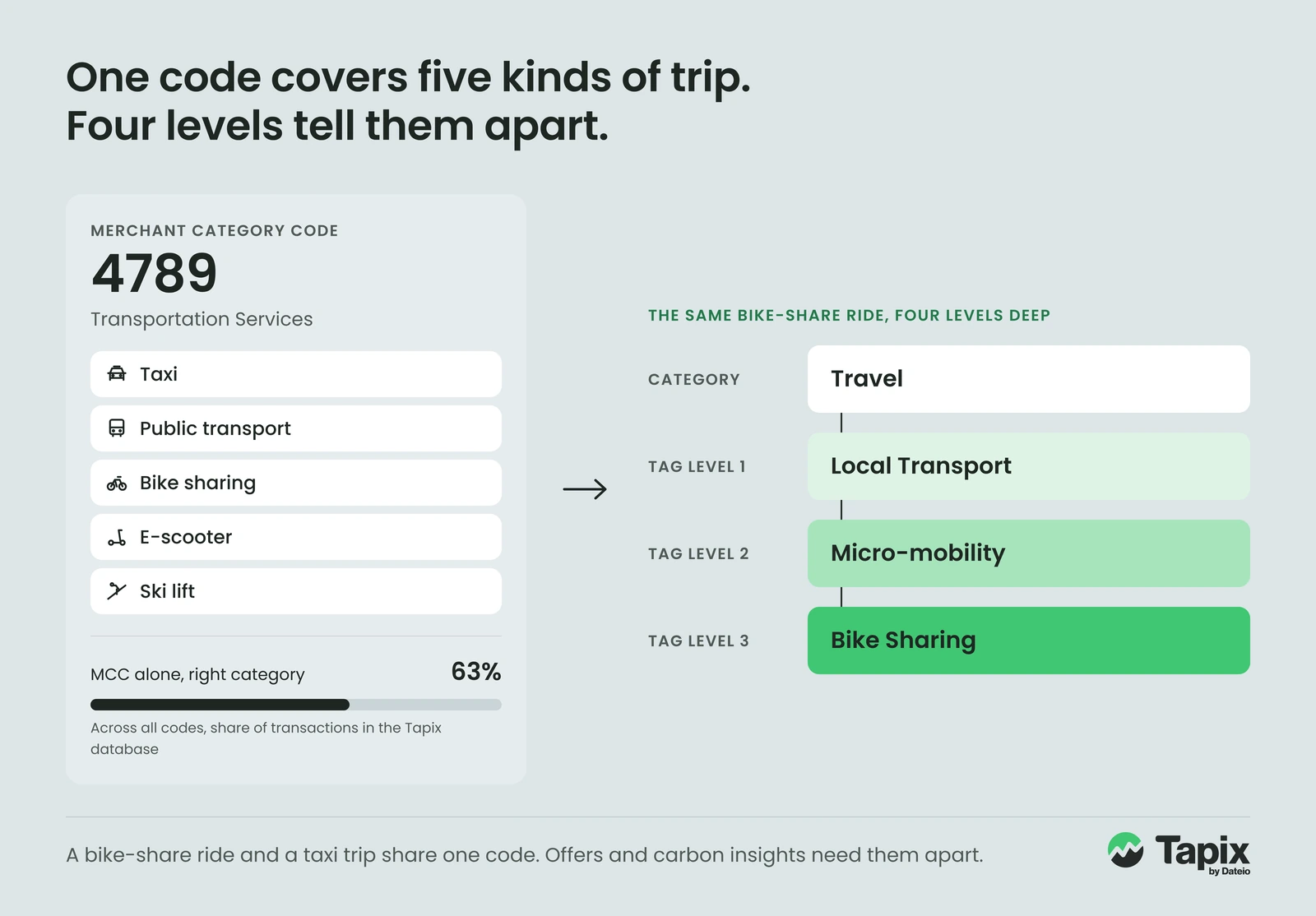
Transport shows how the levels differ. MCC 4789, Transportation Services, puts taxis, public transport, bike sharing, e-scooters and ski lifts under one number. In the four-level model, a bike-share ride reads as:
- Category: Travel
- Tag level 1: Local Transport
- Tag level 2: Micro-mobility
- Tag level 3: Bike Sharing
Tags attach to the individual shop, and one shop can carry several tags from different categories. A café that also sells bread and packaged coffee carries Café, Bakery and Groceries tags at once. A hotel with a bar and a music venue carries Hotels and Guesthouses alongside Bar. That is how the model describes businesses that sit between industries, where a single code has to pick one.
Even codes that look clean split apart at tag level. In the Tapix database, 78% of Groceries transactions carry MCC 5411 Grocery Stores and Supermarkets, yet the merchants behind them spread across 31 different tags. To a budgeting screen they are all groceries; to an analytics team, an organic shop, a convenience store and a hypermarket describe three different customers.
Because tags belong to the merchant and the shop, they also work where there is no MCC at all. A bank transfer, a QR payment or an open banking record is categorised from the recipient itself and, where available, the payment details. The same category tree then covers every payment type a bank processes.
Perspective: bank structures and client rules
Depth gives every bank the same detailed picture. Perspective decides how that picture appears to the bank's customers, and to each business client.
The bank's own category tree
Most banks already have a category tree in their app, usually with fewer and broader categories than any enrichment model. Customers know it, reports are built on it, and nobody wants to replace it. Multi-level categorisation maps into that tree instead, and the mapping deserves as much attention as the categorisation itself.
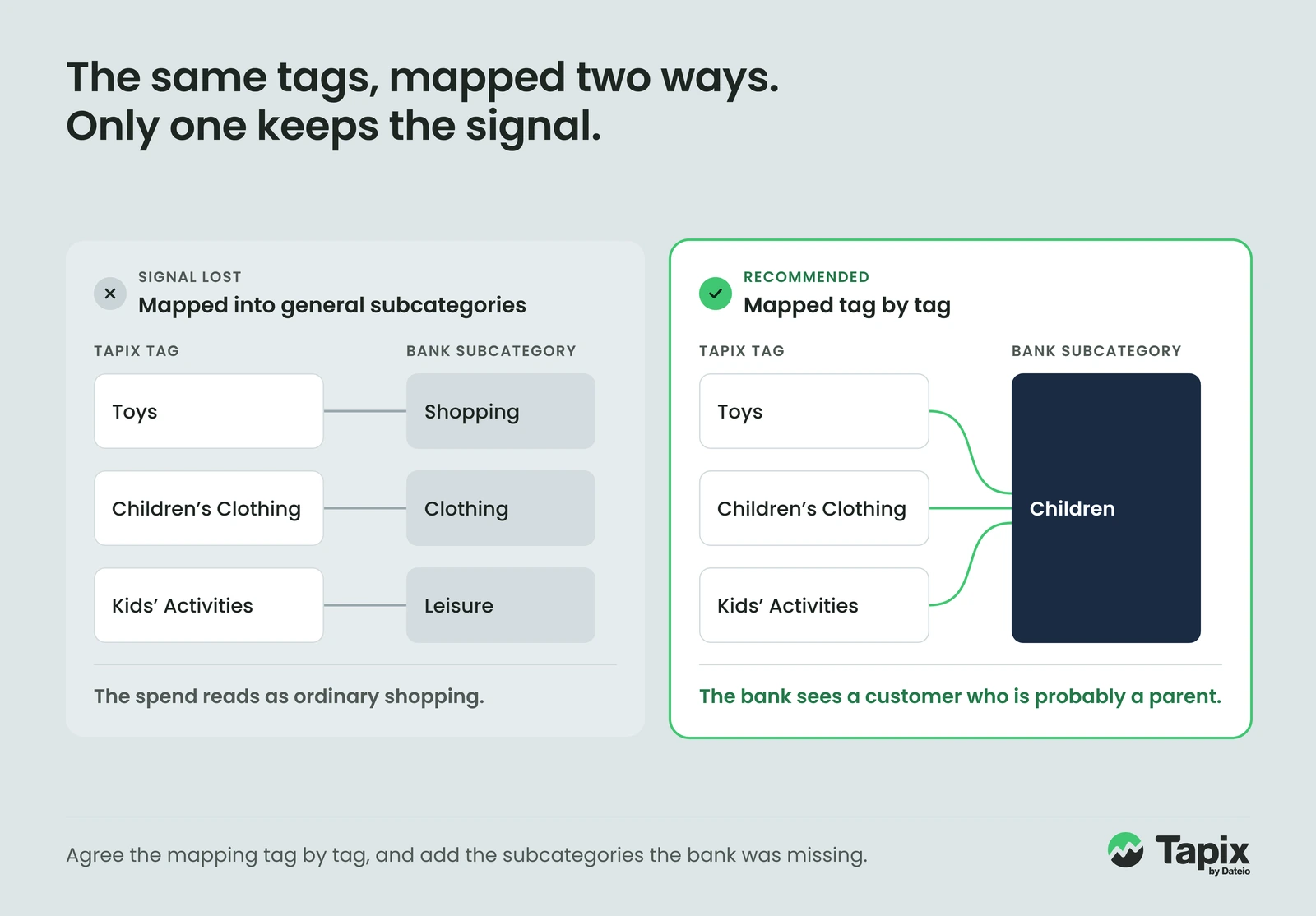
Mapping runs through the most detailed level. Each tag maps to one of the bank’s subcategories, and the subcategory then sets the bank’s category:
Mapping a detailed model into a smaller one always trades some detail for familiarity. When a shop carries several tags, one has to decide the subcategory, usually the most specific. When the bank’s tree has no home for a whole category, a signal can disappear. Toys, Children’s Clothing and Kids’ Activities scattered across general subcategories no longer tell the bank that the customer is probably a parent. The strongest implementations treat the mapping as a product decision, agreed tag by tag, and add the subcategories the bank was missing.
The business client's rules
For business clients, perspective goes one level further, because the right category depends on who is paying. Fuel is a production cost for a transporter, an operating expense for a consultancy and a project cost for a construction firm. The MCC is the same, the merchant is the same, and so is the tag.
Today, finance teams sort this out later, often by hand in accounting software, and every correction stays outside the bank. Rule-based categorisation brings that work inside. A finance manager corrects a transaction once and the correction becomes a rule, scoped to a merchant, a card or user, a cost centre, or a combination.
Tailoring SME transaction categorisation to each business client covers how those rule levels work in practice.
Rules hold only as well as the layer beneath them. A rule keyed to Shell has to recognise Shell under every descriptor variant, at every station, in every country the client's drivers cross. That is why the client's level sits on top of merchant recognition and the tag tree, never on top of the raw MCC.
Which level each banking solution needs
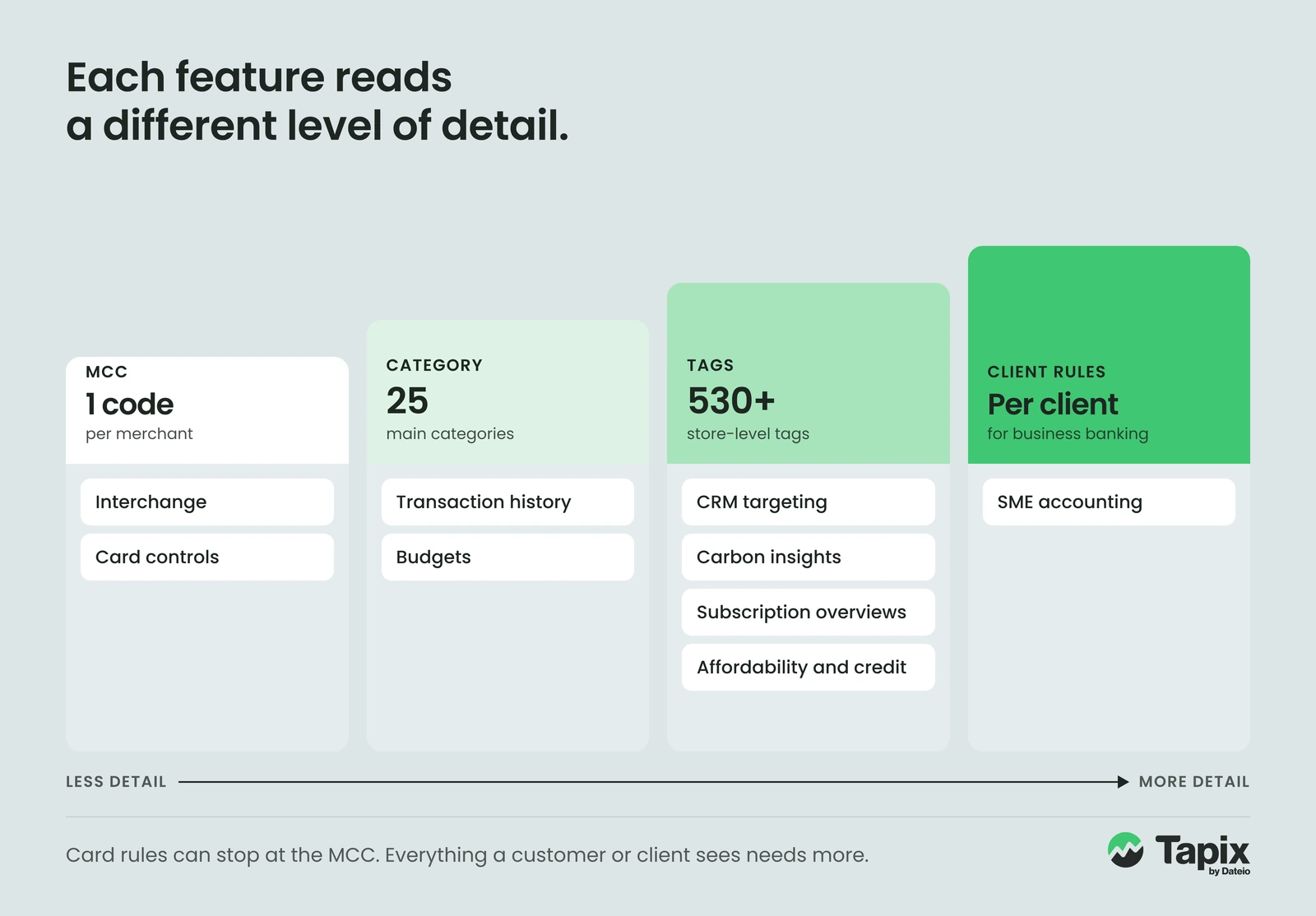
The practical question for a product team is the minimum level each feature on the roadmap has to read from. The MCC keeps its place in the stack, everything a customer or a client sees needs more.
Affordability is where the stakes are rising fastest. The Consumer Credit Directive (CCD2) applies from 20 November 2026 and requires lenders to base creditworthiness assessments on relevant, accurate information about the applicant’s income and expenses. Income and expense segments built from the account history itself are evidence a lender can show, while figures the applicant types into a form are not. Smart data for credit scoring explains how those segments are built.
The SME row is where the bank gains the most. Once business clients categorise inside the bank, the bank holds something it never had: how each client actually runs its costs. That data stays in the bank's platform, instead of in a spreadsheet the bank never sees.
An MCC remains a useful first signal, and enrichment still reads it. Banks that treat it as one input among several, and read each transaction at the level a feature needs, build products their customers and their own teams can rely on. Tapix delivers the category, the tags and the bank's own mapping in the same API response as the merchant name and logo, with client-level rules on top for business banking.
