AI in banking in 2027 is not a question of adoption, but how far it goes beyond efficiency. More than 80% of financial services firms are adopting AI at some level, and 52% are already experimenting with agentic AI. So far, the payoff is efficiency gains rather than business model transformation, according to the Cambridge Centre for Alternative Finance. The regulatory picture has also shifted since the AI Act was adopted. Here is what banks are actually doing with AI now, and what changes over the next 12 months.
Want to know more? Read our step-by-step guide to AI Act compliance for banks.
Where AI banking stands in 2027
Adoption is wide but shallow. The CCAF’s 2026 Global AI in Financial Services Report found that 40 percent of firms report advanced adoption (“Scaling” or “Transforming”), but four of the top five use cases are still back-office functions. The survey covered 628 respondent organisations across 151 jurisdictions, including 203 fintechs, 149 financial incumbents, 146 AI vendors and 130 central banks and regulators.
The gap between generative AI and agentic AI is wider than the headlines suggest. In Bank Director’s 2026 Technology Survey, 72% of respondents said their institutions use generative AI, but only 30% are deploying agentic AI.
What holds banks back has not changed in six years. The CCAF names data quality, talent and legacy architecture as the core constraints to adoption and scaling, the same top barriers its 2020 report identified. That finding runs through every use case below.
AI assistants: from chat window to everyday banking channel
In 2024, a banking assistant was a differentiator. Today it is expected. Bank of America’s Erica is the longest-running example: the bank’s March 2026 report put 2025 activity at 20.6 million users and nearly 700 million interactions, taking the cumulative total past 3.2 billion since launch.
Wells Fargo moved faster from a later start. Its assistant Fargo passed 1 billion interactions less than three years after launch, and more than 3 million Spanish-speaking customers have used it over 160 million times. That last figure matters for inclusion: an assistant that works in the customer’s language lowers the barrier more than any redesigned menu.
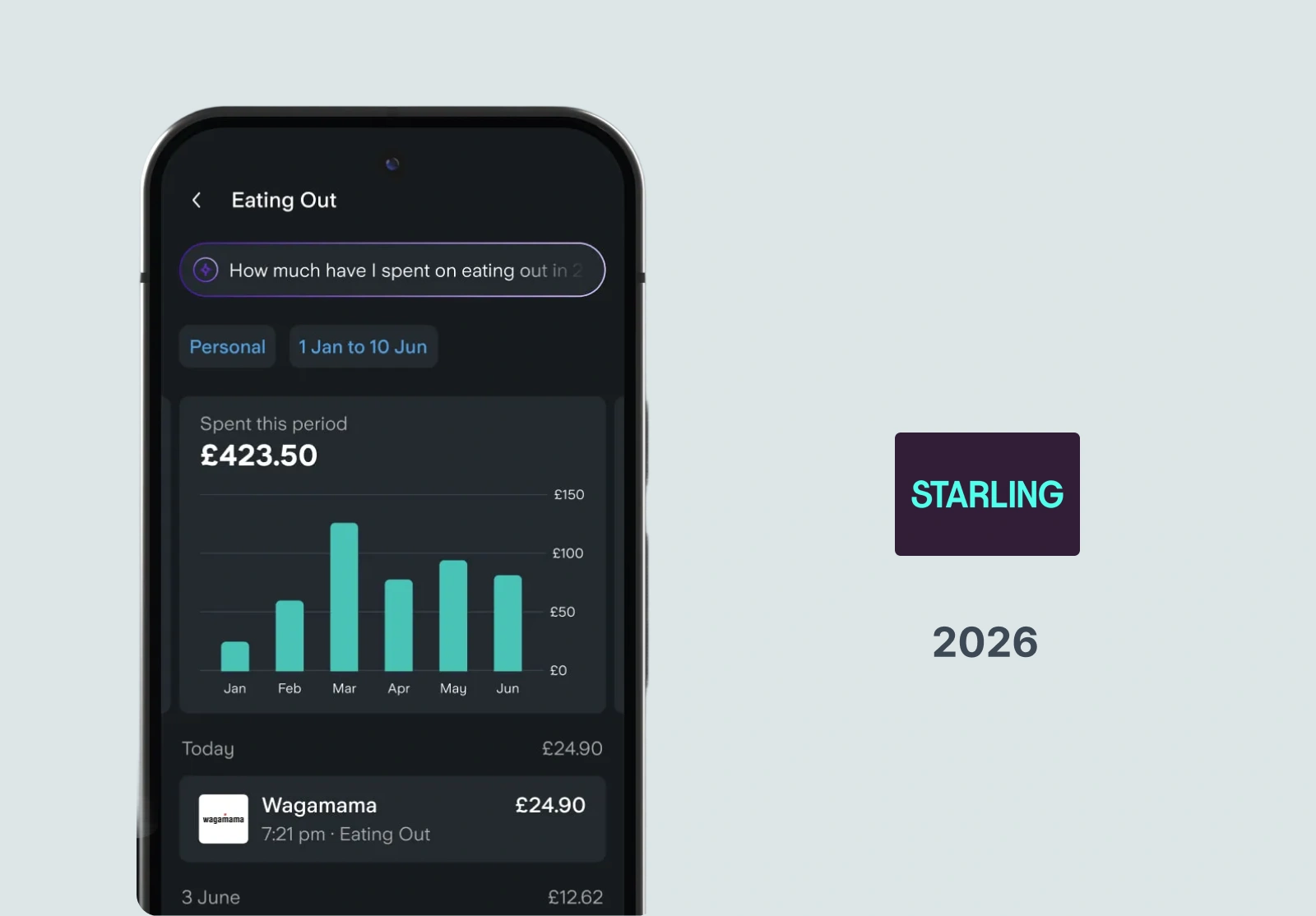
Do it right: bunq launched Finn in December 2023 and has rebuilt it several times since. Users rely on it most for card services, payments and savings, and the single most common question it answers is how much the user spent on groceries this month. That question looks simple, but the answer is only as right as the categorisation underneath. If a supermarket payment is filed under “general retail” or a card terminal string is never resolved to a merchant, the assistant answers confidently and wrongly. For a side-by-side view of how bunq, Starling and Revolut built their assistants, read our comparison of AI assistants in banking.
Because assistants are now standard, the bar has moved. eMarketer’s 2025 benchmark found that a virtual assistant in a mobile app is no longer special; the next level is a clean handover to a live agent when the assistant fails to resolve an inquiry.

Agentic AI: when the assistant starts acting
Agentic AI is AI that executes a task instead of recommending one. Inside banks, that still mostly means operations. In Bank Director’s survey, every bank and credit union FinXTech interviewed said humans consistently review the work agents perform, and 83% of agentic deployments are embedded in existing third-party applications rather than built in-house.
The customer-facing shift is happening in payments. In March 2026, Visa launched its Agentic Ready programme first in Europe, including the UK, to help issuers prepare for agent-initiated payments, with Romania’s Banca Transilvania among the early participants. By July, Visa announced live agentic commerce transactions across Europe, explicitly authorised by the consumer, with agents operating within limits the user defines. Mastercard reports that all its issuers in Europe are now enabled at network level for Agent Pay, with banks across the region completing controlled live agentic transactions using passkeys.
For banks, the practical consequence sits in the transaction feed. When an AI agent buys something on a customer’s behalf, the customer still sees a line in their app afterwards, often days later and with no memory of the purchase. If that line shows a random acquirer string instead of a recognisable merchant, the bank gets a support call or a dispute it could have avoided. Agentic commerce raises the value of clear merchant identification.
Fraud detection in the age of AI-made scams
AI now sits on both sides of fraud. UK Finance’s Fraud Report 2026 shows payment fraud losses of £1.28 billion in 2025, with authorised push payment fraud up 19% to £576.4 million, as criminals use deepfakes and synthetic identities to impersonate trusted people. On the defensive side, banks prevented £1.68 billion in unauthorised fraud over the same period.
The hardest cases are the ones where the customer authorises the payment themselves. In Visa’s Spring 2026 Biannual Threats Report, the network warned that scams have become one of the most significant drivers of consumer harm in payments, driven largely by AI-enabled impersonation, deepfake content and social engineering.
Detection models need context to tell a normal payment from a coached one: who the merchant is, what category it belongs to, where the terminal is and whether this customer has paid there before. Enriched transaction data gives fraud models those signals, and gives customers merchant details they recognise, which also cuts friendly fraud disputes and chargebacks.
Process automation and internal AI
The CCAF data confirms that most AI value today is internal. JPMorgan Chase is the clearest large-scale case.
Do it right: At its February 2026 company update, JPMorgan said its internal LLM Suite is used by roughly 150,000 employees weekly, with users estimating around four hours of time saved each week. AI-driven transaction screening has more than doubled processing volumes and halved manual checks. The transaction screening result is the one to watch: it is a data-heavy task where the quality of the input decides how many cases still land on a human desk.
Smart search inside the app belongs here too. Natural-language search (“show me what I paid at the airport in May”) only works when every transaction carries a clean merchant name, a category beyond the MCC code and a location. That is the same contextual understanding that makes an assistant’s answers trustworthy.
Credit risk assessment under CCD2 and the AI Act
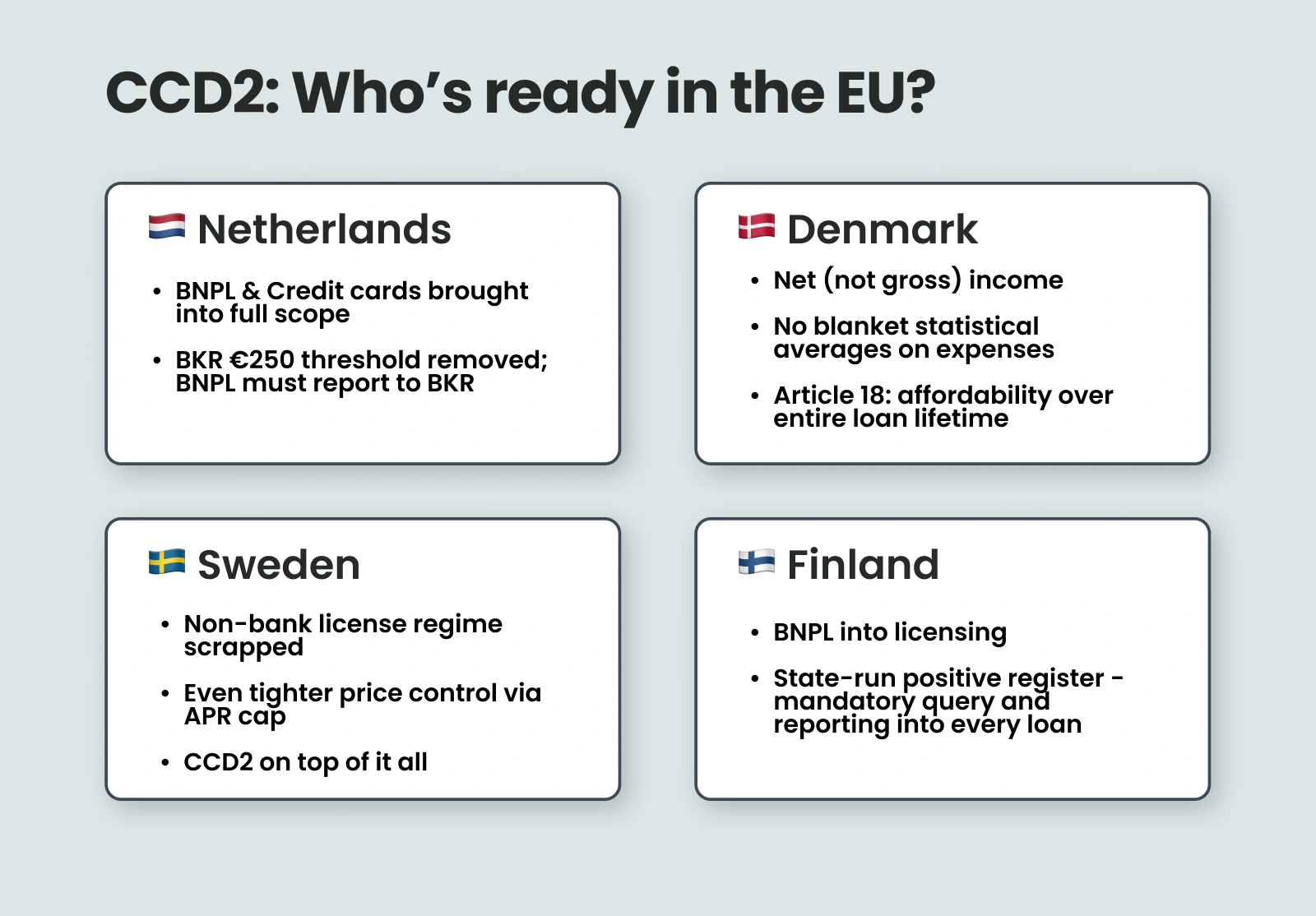
Two regulatory clocks now run in parallel for lenders. The revised Consumer Credit Directive (CCD2) applies from 20 November 2026 and strengthens creditworthiness rules: creditors may only extend credit if the assessment has a positive outcome. It also brings in rights to an explanation of automated creditworthiness assessments and to human review. Transposition is uneven: 23 of 27 Member States missed the November 2025 transposition deadline, so the exact rules will vary by market for a while.
The AI Act timeline moved. The Digital Omnibus (Regulation (EU) 2026/1744, in force since 27 July 2026) moved Annex III high-risk obligations, which cover credit scoring, from 2 August 2026 to 2 December 2027. The delay is narrower than it looks: only the high-risk system obligations were deferred, and obligations on general-purpose AI model providers, which sit underneath many credit and fraud-scoring tools, were untouched.
For credit teams, both regimes point the same way: decisions must be explainable, and explanations rest on the data that fed them. A model that infers income stability from transaction history has to show which payments it counted as salary, rent or a recurring loan repayment. That is where categorised open banking and card data for creditworthiness assessment earns its place, and why the read layer of open banking matters more than the payment layer here (we cover the split in AISP vs PISP).
AI-powered personal finance management
PFM is where AI and transaction data meet most visibly. Budgets, spending summaries, subscription alerts and savings nudges all start from the same step: turning a raw payment string into a merchant, a category and, for recurring payments, a billing pattern. AI can then do the interesting part, from spotting a price rise on a subscription to suggesting a realistic savings goal.
Did you know? High-quality data is essential for AI to work properly. Read our take on why.
Most banks still build this with external providers rather than training their own categorisation models. Tapix categorises transactions into 25 merchant categories and 530+ store-level tags, and Recurring Payments Intelligence adds frequency, next billing date and amount to each recurring payment. We explain how the layers fit together in how enrichment expands personal finance management.
What decides how far AI in banking goes next
The banks getting real value from AI in 2027 share one trait: they fixed their data before scaling their models. An assistant, an agent, a fraud model and a credit model all read the same transaction feed, and each one inherits its errors. With CCD2 in force and AI Act high-risk obligations arriving in December 2027, “the model said so” will not satisfy a customer or a supervisor.
Tapix enriches 4bn+ transactions a month for 90+ banks and fintechs across 140+ markets, getting one transaction wrong in every six million. For banks putting AI in front of customers, that accuracy is the difference between an assistant people trust and one they stop asking.
Industry leaders share digital banking insights at the top fintech conferences of 2027.
