Visa's enhanced merchant data requirement lands on 23 January 2027, and its subscription management rules have been in force since 18 April 2026. Mastercard got there first: AN4569 has required the same core merchant data since October 2023. The two mandates share one goal: cardholders should be able to recognise every transaction in their banking app, and the data requirements overlap substantially. A bank that builds a single enrichment layer to the right quality standard covers both.
This article maps what the Visa and Mastercard transaction data mandates require, where they align, and what the combined compliance picture looks like in practice.
Visa issuer requirements: two deadlines, three obligations
Visa's European issuer requirements come in several waves. The first is subscription management and cardholder controls under §7.9.2, which has been in force since 18 April 2026 across 13 markets: Belgium, Croatia, Czech Republic, France, Hungary, Italy, Luxembourg, Poland, the Republic of Ireland, Romania, Slovakia, Slovenia, and the UK. The second is enhanced merchant data display, which takes effect on 23 January 2027 across a broader but distinct European country scope.
The subscription management requirement covers three transaction types: recurring, instalment, and unscheduled credential-on-file. It also requires merchant-level stop instructions, correct decline responses, and cardholder notification when a card stop leaves an underlying merchant contract in place. The cardholder controls requirement adds card freeze and unfreeze, and the ability to block or limit card-present and ATM transactions from within the banking app.
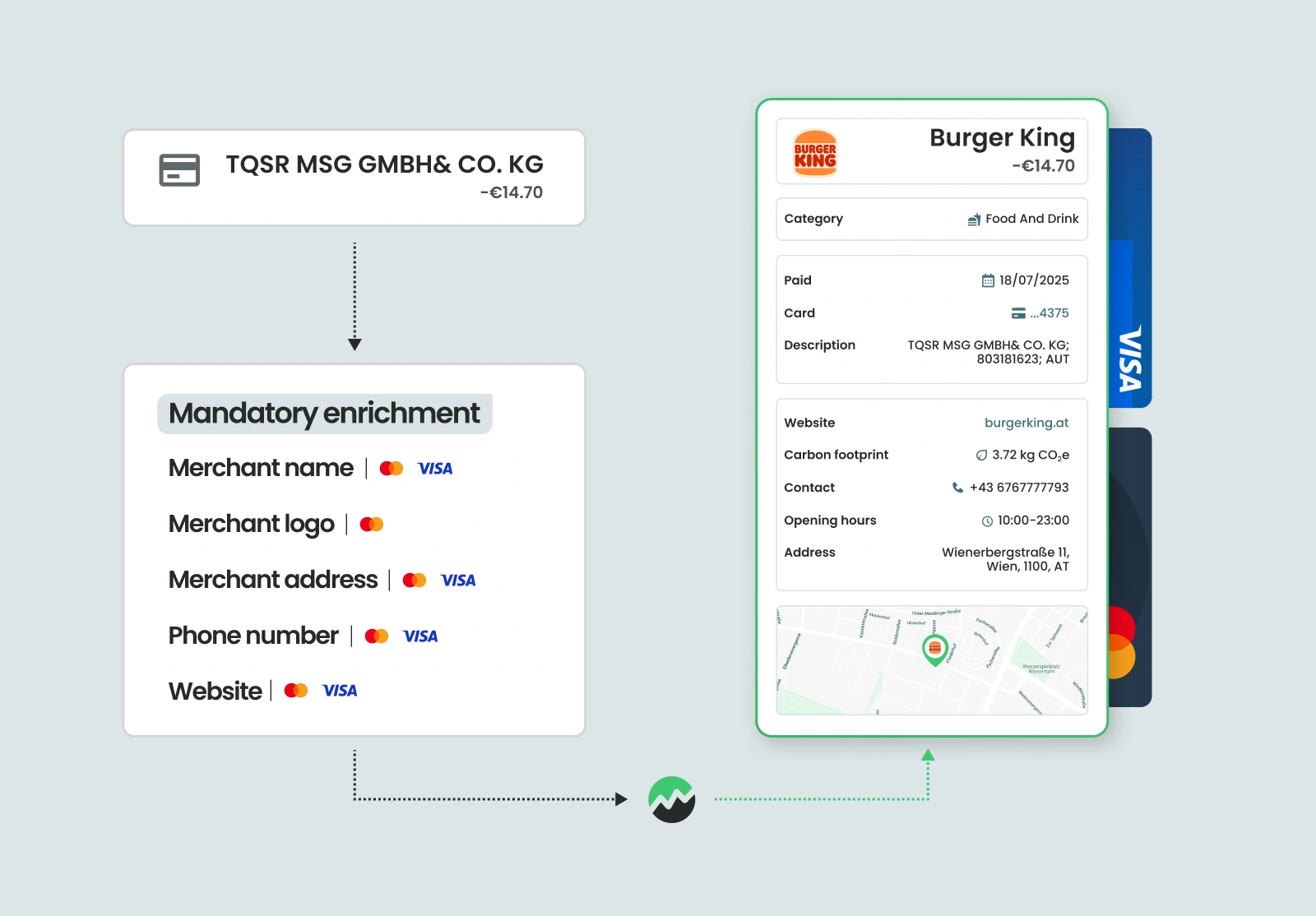
The 23 January 2027 enhanced merchant data requirement covers the merchant name (DBA), street address for card-present transactions, primary phone number, and merchant website. This is the Visa equivalent of what Mastercard required in 2023, applied to the same core goal: cardholder recognition at the point of querying a transaction.
For the full Visa breakdown, see Visa's issuer requirements for 2027. For the subscription requirement at implementation depth, see the Visa subscription management guide.
Mastercard AN4569: in force since October 2023
AN4569 applies to issuers across all European markets. Its country scope is broader than Visa's, and it includes markets that fall outside Visa's current requirements, such as Austria, Estonia, Latvia, and Lithuania. The mandate requires issuers to display enhanced merchant data in digital banking channels: the merchant's public-facing or doing-business-as name, location, contact details, and logo, when available.
The core compliance requirement is merchant identity clarity. The cardholder should be able to recognise what a transaction is and who the merchant is the moment they see it in their app. The mandate covers both card-present and card-not-present transactions, and applies across the issuer's banking application, mobile wallet, and internet banking interface.
For the full data point breakdown and compliance detail, see the Mastercard AN4569 compliance guide for banks.
Side-by-side comparison
Where the requirements overlap
The shared foundation across both mandates is merchant identity: the cardholder-facing name, address, and contact details that make a transaction recognisable. A bank building a compliant enrichment layer for Mastercard AN4569 is building the same data foundation that Visa's January 2027 enhanced merchant data requirement will call on.
For issuers already compliant with AN4569, the January 2027 Visa deadline builds on existing infrastructure rather than requiring a separate project. The key question is whether the enrichment coverage and accuracy already in place is sufficient for the Visa data point requirements. The two are closely aligned but specified slightly differently. Visa, for instance, distinguishes card-present address requirements from card-not-present, where Mastercard's language is more general. Mastercard also requires the merchant logo; Visa does not.
Visa §7.9.2 subscription management sits outside the scope of AN4569 and requires additional capability: transaction-level recurring payment detection, type classification, and stop instruction logic built on a stable merchant identity layer. Issuers addressing this requirement need both the enrichment foundation and recurring payments detection on top of it.
The detection solution for subscriptions and recurring payments in digital banking covers how that layer works.
What compliance enables beyond the baseline
Clean merchant identity enables personal finance management, card-linked offers, and hyper-personalised communication. Recurring payment detection enables proactive subscription alerts, spend summaries, and the kind of subscription visibility that Revolut has built into a retention feature.
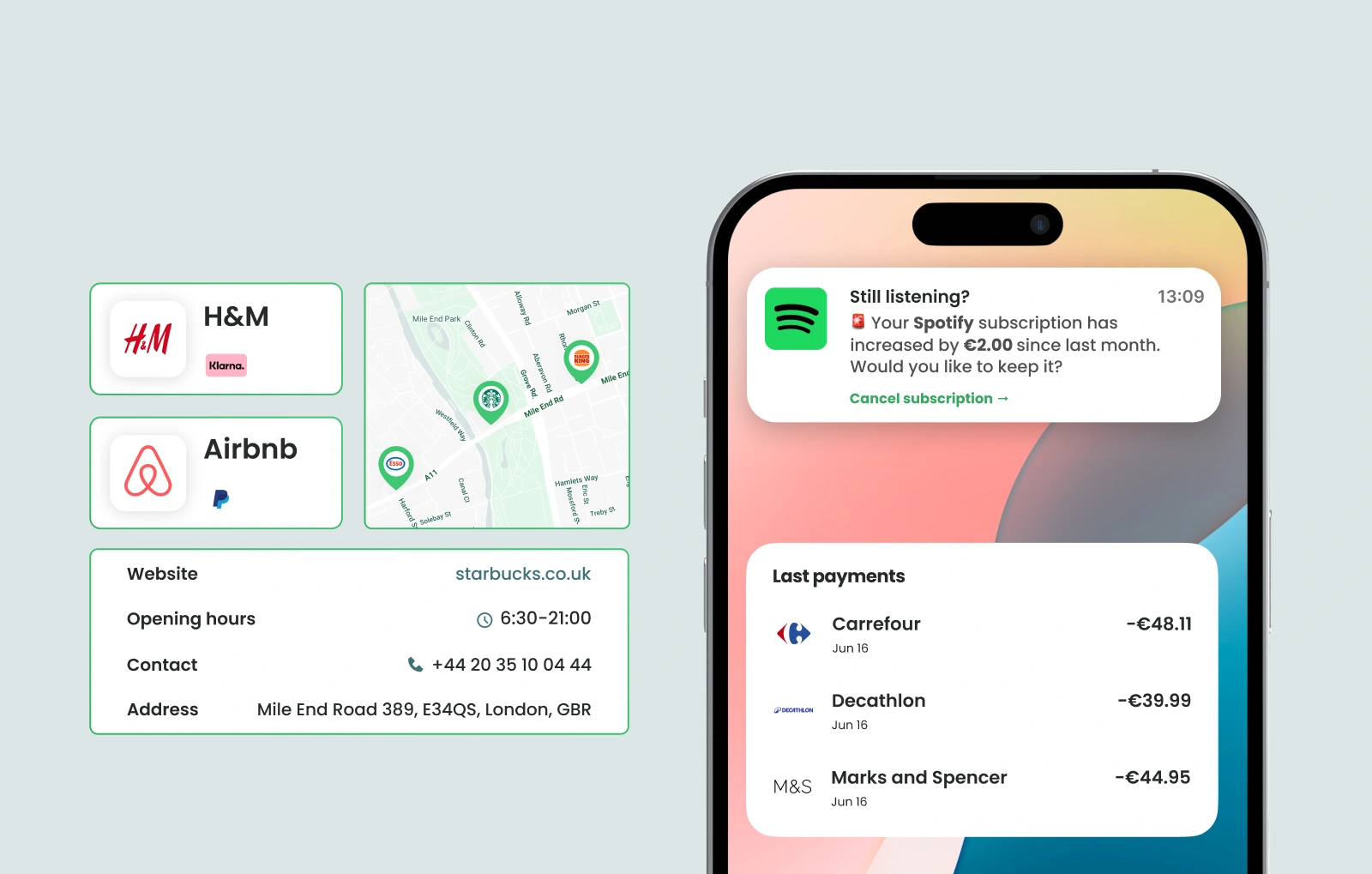
The point here is narrow: compliance investment has compounding returns when the data quality is right. A bank that treats the mandate as a one-off display fix gets a display fix. A bank that treats it as a data layer gets the foundation for everything built on top of it.
That is why the data quality standard matters as much as the data points themselves. Coverage, accuracy, and information richness determine whether the same enrichment integration can carry features beyond the baseline, or whether it only ever clears the minimum. The Visa and Mastercard mandate compliance solution is built around that single shared layer.
One data layer for both networks
The cleanest way to read the combined picture is as a single requirement with two regulatory expressions. Both networks want cardholders to recognise their transactions, and both rely on the same underlying merchant identity data to make that happen. One enrichment integration, built to the right coverage and accuracy standard, covers both mandates and leaves room to build beyond them.
That is the practical case for treating this as data infrastructure rather than a compliance checkbox. Tapix mandate compliance is built around the shared layer: recognisable merchant identity across both networks, from one integration, with the headroom to go further when the bank is ready.
