The banking economics of the next three years are already known. In practice, banking economics comes down to where a bank puts its next euro of investment, and what return it expects. Europe’s largest banks have published their plans for 2027 to 2030 in strategy decks and results calls, and the same four priorities run through all of them: AI assistants that complete tasks, primary-bank status, data-driven credit decisions, and instant payments with tighter fraud controls. Together, they show where European banking economics is heading, and what each priority asks of the data underneath it.
Where European banks are putting the money
AI is the fastest-growing line in European bank budgets. The European Banking Authority’s Risk Assessment Report from June 2026 describes a sector that is accelerating AI adoption with rising investment. The money is going into automation, risk management, financial advisory, customer service and fraud detection. The EBA’s own survey data shows the pace: generative AI use among surveyed EU banks rose from around 40% at the end of 2024 to over 60% by the first quarter of 2025.
Fraud is the counterweight to that spending. In the EBA’s autumn 2025 risk assessment questionnaire of 85 European banks, fraud ranked as the second most relevant contributor to operational risk, with 55% agreement. The EBA links that rise directly to digitalisation and the growing use of AI.
AI assistants that complete tasks for customers
The first generation of banking chatbots answered FAQs. The generation European banks are funding for 2027 resolves the request end to end.
BBVA has made AI the axis of its 2025–2029 strategic plan. Its assistant Blue is designed as a personalised 24/7 assistant for every customer, and a partnership with OpenAI signed at the end of 2025 is meant to speed up rollout. In the first half of 2026, the bank went a step further and created a dedicated AI Transformation unit to carry AI across the whole organisation.
KBC is furthest along in production. Its assistant Kate served 6.2 million users in Q2 2026, resolving 77% of queries without human intervention in Belgium. ING reports a similar trajectory. More than 75% of its chats are resolved without human support, and agentic mortgages are live in production.
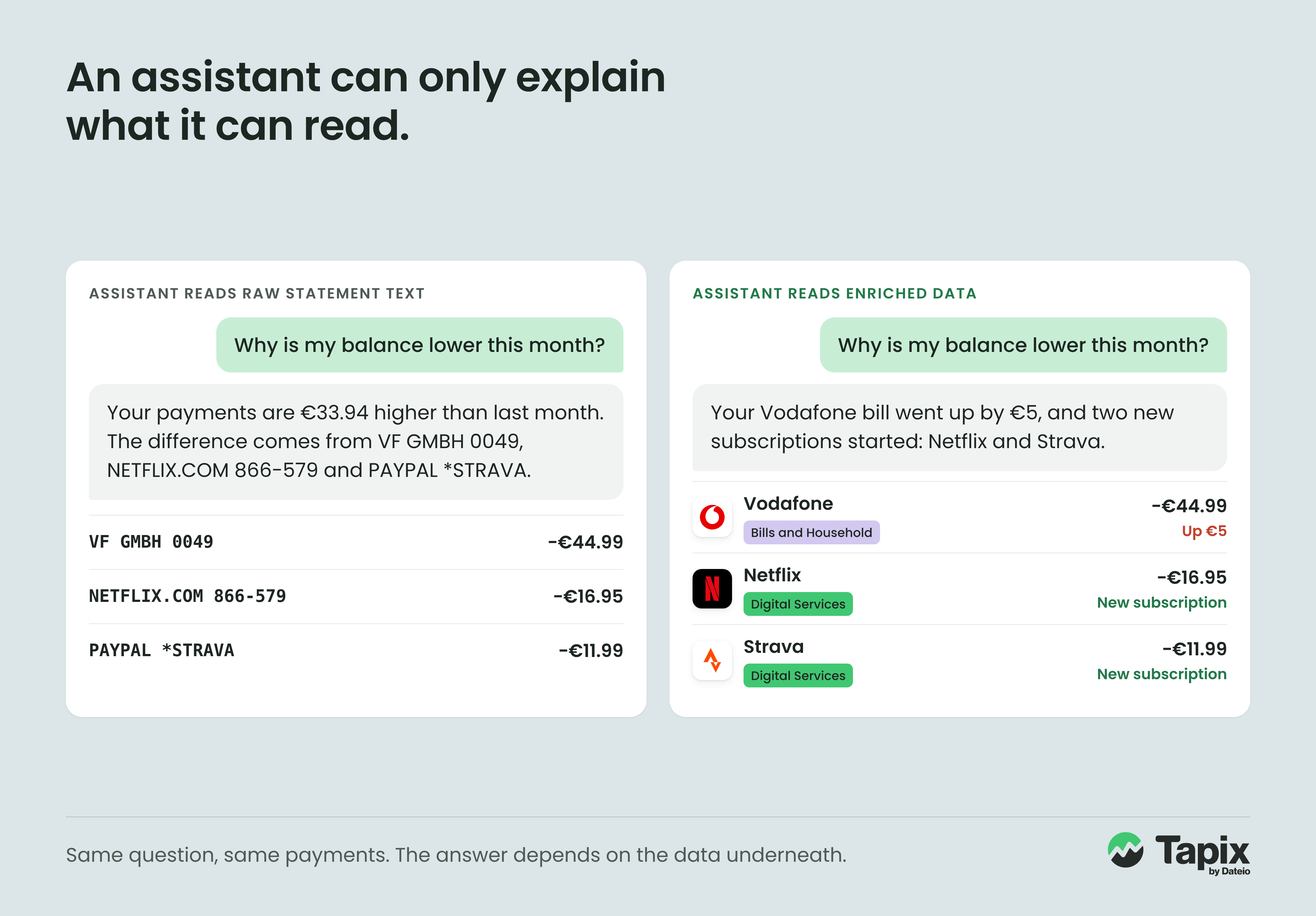
But as we know, an assistant is only as useful as what it can read. A customer asking why their balance is lower this month needs an answer built from merchants and recurring payments.
Learn why the AI assistants of bunq, Starling and Revolut differ so much once you compare what each is allowed to see.
Becoming the customer’s primary bank
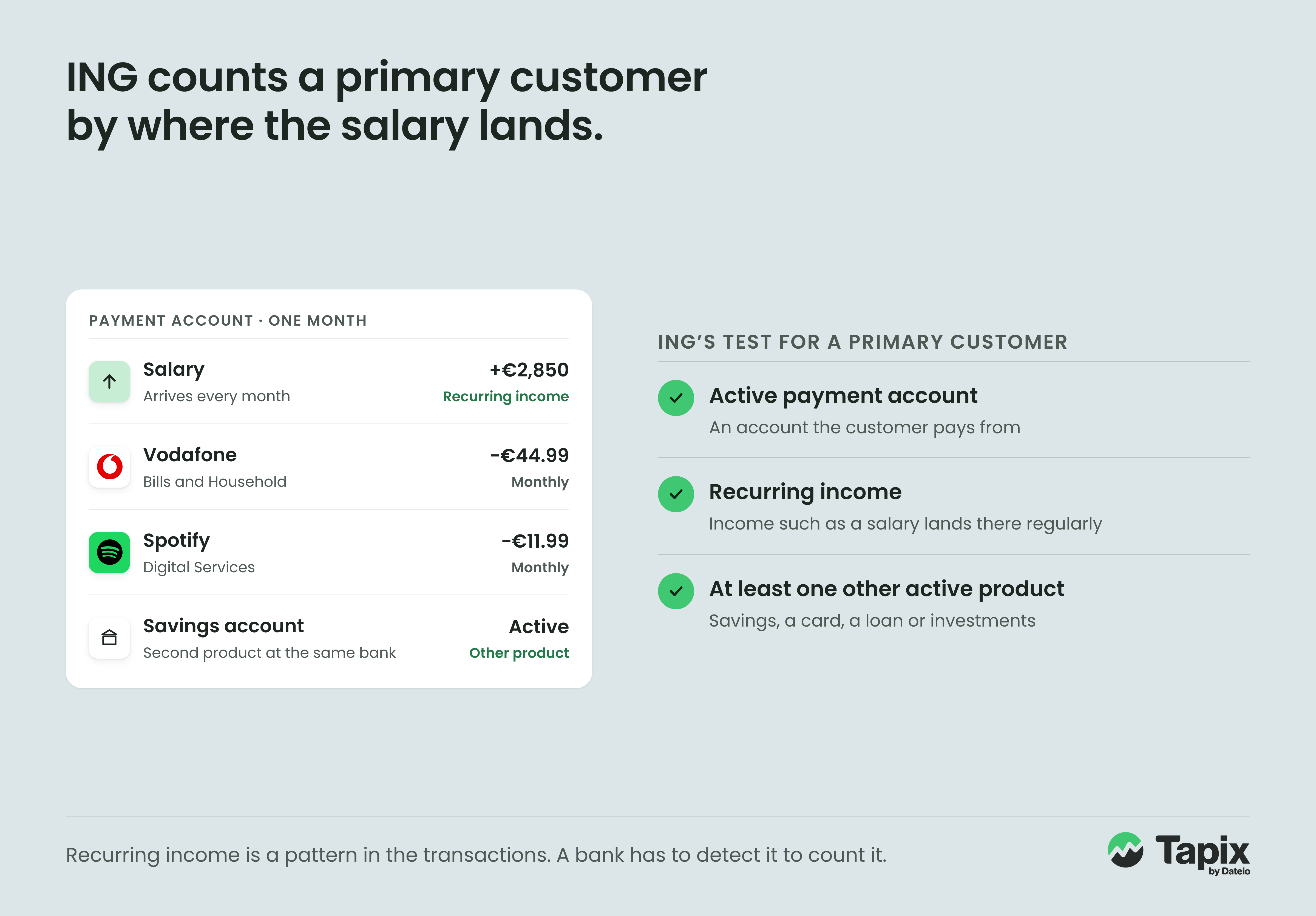
Primary status is now the KPI European banks put in front of investors. ING targets more than one million new mobile primary customers every year through 2027. It defines a primary customer as someone with an active payment account receiving recurring income, plus at least one other active product. The definition measures what matters: the salary landing and the bills going out, which is the relationship that deposits and cross-sell come from.
Revolut is chasing the same prize at a larger scale. It aims to reach 100 million retail customers by mid-2027, backed by a £10bn investment plan over five years. In an interview with CzechCrunch, the head of Revolut Bank said the number of customers with a primary relationship is growing much faster than the customer base as a whole.
Banks keep primary status by making the account the clearest place to see what the salary is already committed to.
Read more about the topic in our digital banking engagement playbook.
Credit decisions built on better data
Credit is where European banks plan the most specific automation. PwC’s European Credit Risk Survey 2026 found that credit decisioning automation is the top technology priority in credit risk, named by 29% of banks. Early warning systems with predictive triggers follow at 23%.
Erste shows what this looks like in production. The group combines machine learning models that predict individual client behaviour with mathematical optimisation to set loan pricing and limits across its markets. According to FICO, which supplies the technology, the approach delivered a 22% profit increase.
Two regulatory dates frame this work:
- CCD2 (20 November 2026). Lenders must base creditworthiness assessments on relevant, accurate information about income and expenses, which makes choosing an open banking data provider a credit decision in its own right. Through AISP access, that data can also cover applicants whose main account sits at another bank.
- AI Act (2 December 2027). AI systems that assess the creditworthiness of individuals fall under the AI Act’s high-risk obligations from this date, after the Digital Omnibus moved the deadline from August 2026.
Both rules reward lenders who can show exactly which income and expense data a decision rested on.

Instant payments and fraud controls
For banks outside the euro area, 2027 is a payments year. Under the EU Instant Payments Regulation, banks in non-euro member states that offer euro transfers must be able to receive euro instant payments by 9 January 2027. By 9 July 2027, they must also send them and offer Verification of Payee.
Card rules move in the same month. Visa’s European requirement, the counterpart to Mastercard’s merchant-data rule, takes effect on 23 January 2027. From that date, issuers must show cardholders who they actually paid.
See the issuer checklist in our Visa mandate guide.
Both deadlines share a purpose. Money that moves in seconds needs equally fast certainty about who sits on the other side of the payment. Fraud teams depend on that same certainty, which is why the EBA’s fraud warning and these mandates point in one direction.
Banking economics: fund the shared layer once
Put the four priorities side by side and they draw on the same input:
- an assistant explaining a balance
- a primary-bank strategy built on salary and bills
- a credit model evidencing affordability
- a fraud check on a payee
All four read the bank’s transaction record, merchant by merchant and payment by payment.
A bank that scopes these as four separate projects ends up cleaning and classifying that record four times, once per team. The efficient alternative treats enriched transaction data as shared infrastructure, built or bought once and used by every priority. Building it in-house is a real option, though the costs of in-house enrichment tend to grow after launch. This is the layer Tapix provides: merchant identity, categorisation and recurring-payment detection through a single API that every one of these teams can call.
Europe’s largest banks have already chosen their priorities for 2027 and beyond. For everyone else, the open question is how quickly these plans travel to their own markets.
